Episode transcript
Libbe HaLevy
00:00:01
One would hope that a report on Fukushima radiation coming from the United nations scientific committee on the effects of atomic radiation or unsere would contain accurate information that would inform the world of the truth about what really happened at that nuclear disaster. But when a genuine expert from the international physicians for the prevention of nuclear war reveals the source of UNS scares data,
Dr. Alex Rosen
00:00:29
They take as the single source of their calculation of internal radiation, the international atomic energy agency, the I E E a. And we all know that the I a E a was founded in order to promote civil nuclear energy. So they don't have a very big interest in actually showing a lot of negative effects of the Fukushima nuclear disaster.
Libbe HaLevy
00:00:51
Well, when you hear that the United nations has been using such blatantly biased pro-nuclear data sources to assure us that when it comes to Fukushima's radiation, they're there. Miss see, don't worry or pretty little ahead about it. That's when you begin to suspect that once again, you and I, and everyone else are in the seat that we all share
Announcer
00:01:15
New clear, hot seat. What are those people thinking? New clear, hot seat. What have the boys been drinking? New hot seat? The is sinking. Our time to act is shrinking, but the activists are licking new hot it's de bomb.
Libbe HaLevy
00:01:48
Welcome to nuclear hot seat, the weekly international news magazine, keeping you up to date on all things nuclear from a different perspective. My name is libi Hal levy. I'm the producer and host as well as a survivor of the nuclear at accident at three mile island from just one mile away. So I know what can happen when those nuclear so-called experts get it wrong. This week, we revisit one of nuclear, hot seats, most important interviews with Dr. Alex Rosen of the international physicians for the prevention of nuclear war. We speak about that group's analysis and SmackDown of the United nations UNS obscure report on Fukushima's radiation impact. It's an object lesson complete with footnotes of exactly the kinds of manipulation of data and information that the nuclear industry and its co dependen used to excuse so many crimes and transgressions against people and the environment.
Libbe HaLevy
00:02:52
A true cornerstone eye opener will also have nuclear news from around the world, numb nuts of the week for outstanding nuclear bone headedness, and more honest nuclear information than will be raised at the Senate hearings on Brett Kavanaugh. All of it coming up in just a few moments today is Tuesday, September 4th, 2018. And here is the week's nuclear news from a different perspective, starting in the us at the Hanford site in Southeast Washington state, where the possible collapse of a second Hanford tunnel storing radioactive waste is both more likely than thought a year ago, and the effects potentially more severe. According to Hanford officials, the risk of failure based on department of energy, nuclear safety standards has increased from unlikely to anticipated Dan wood, chief operating officer of the C H two M hill plateau remediation company. A Hanford contractor said it would be a significant event with the potential for the airborne release of radioactive particles.
Libbe HaLevy
00:03:59
He went on to say, structural failure has to be anticipated. It's going to happen. It's a 60 year old facility. It is corroded sooner or later, it is going to go. Eastern Washington is an agricultural region with wheat and fruit among the crops exported in Colorado. More controversy around the Rocky flats, proposed new wildlife refuge consisting of the buffer zone around the former plutonium pit manufacturing facility and Superfund site seven Denver Metro area school districts have already barred school sanctioned field trips to the preserve. And a top local health of officials says he would probably never hike there. A town is suing over what the soil might contain though. The area about 20 miles Northwest of Denver claims to have been cleaned up and declared safe by the government. Plutonium remains in the ground where the facility once stood and many doubt the thoroughness of the cleanup will have a full port on this on next week's nuclear hot seat, the defense nuclear facility, safety board, which oversees and reports on safety practices in the newest nuclear weapons complex is under siege.
Libbe HaLevy
00:05:14
Congress created the board almost 30 years ago to address years of lax safety practices. Now the energy department is seeking to block the access to safety information. Excluding the board from overseeing worker protection at dozens of facilities and blocking board staff from interacting with contractors that operate the nation's nuclear sites. We'll have links up to two articles on this very important issue. One by Bob Alvarez, from the bulletin of atomic scientists, safety in the nuclear, your weapons complex, and by Rebecca boss of the Santa Fe, new Mexican and ProPublica nuclear safety board slams energy department plan two weaken oversight. The links will be up on the website, nuclear hot seat.com under this episode, number 3, 7, 6, and now
Announcer
00:06:01
Nuclear hot seed nuclear hot seed nuclear hot seed, none sound
Libbe HaLevy
00:06:10
An air force. B2 stealth bomber has test dropped an upgraded multi fun B 61 dash 12 nuclear bomb over Southern Nevada. It happened earlier this summer at Ellis air force base in Southern Nevada marking a new developmental flight test phase for the upgraded bomb. According to the air force, the article reporting, this does not say it was a dummy bomb or a mockup, a computer simulation, or an imaginary drill. We, the United States of America just dropped a nuclear bomb on itself. Take that Nevada for not wanting Yucca mountain. No word about how high the plane was when the was dropped, who picked it up or from where this article, which you have to chase down a rabbit hole to discover its NeoCon and right wing roots, practically salivates over its subliminally sexualized description of this bomb, which provides. And these are direct quotes, earth, pen trading attacks, low yield strikes, high yield attacks, bunker Buster options and above surface detonation. I guess that last one's the nuclear version of birth control all this to prove that our bangs bigger than anybody else's bang, but it's a nuclear bomb and we are practicing dropping it. No, it didn't go off this time. But a lot of people are hoping that one day it will otherwise, why would they be practicing dropping it and not one word about the result, radiation, fireball, or estimated deaths, nothing but Ooh, baby, baby bust my bunker. And that's why you idiots, who test dropped a nuclear bomb on Southern Nevada. You are this week's
Announcer
00:08:19
Nuclear hot
Libbe HaLevy
00:08:24
In Japan, typhoon JBI, the strongest storm to have hit Japan in 25 years, slammed into the Western coast of that country. The area has 25 operating nuclear reactors in Sendai Genki Chama, Taha, Oki, Moham, ATA, and no word yet on possible impact to the nuclear reactors in a report sent out by Mihi. Morta the former Japanese ambassador to Switzerland Cher noble standards of radiation evaluation were applied to the radioactive contamination of Tokyo results. Show that three wards in Tokyo would have the right to immigrate and two wards and three cities could be placed under contamination surveillance. We are posting that map up on our website and on August 30th, the head of the fisheries industry group in Fukushima prefecture expressed opposition to the idea of releasing water containing radioactive Tridium from the crippled nuclear plant in Fukushima dichi into the ocean. The amount of water tainted with radioactive Tridium continues to increase and TECO is about to run out of suitable sites to construct new storage tanks.
Libbe HaLevy
00:09:40
According to the government, a June, 2016 report by so-called experts suggested releasing the polluted water into the sea after it is diluted with fresh water, but it would not make the radiation any weaker. It would just diffuse it and spread it out and disperse it to a greater area. No solution there in the UK cancer rates at Burnham on sea five miles down, wind of the Hinkley point nuclear power plant is showing cancer rates up to six times higher than average. The study by Dr. Chris Busby found residents are more likely to get kidney cancer, cervical cancer, breast cancer and leukemia and South Africa has dropped its nuclear energy expansion plans and will increasingly harness renewable sources. They won't reconsider this change in policy until 2030 at the earliest. We'll have this week's featured in interview in just a moment. But first I recently came across a list of words that were describing a certain kind of person.
Libbe HaLevy
01:10:45
Those words were kind caring, compassionate, helpful, friendly, fair, hardworking, generous, and honest. And I thought, that's you, you, the listeners of nuclear hot seat. I am deeply grateful to all of you kind caring, compassionate, helpful, friendly, fair, hardworking, generous, and honest people who take the time out of your lives to listen to this show. And I've got a really soft spot in my heart. For those of you who choose to help us out with your support now, full confession. I have a birthday coming up at the end of this month. And if you are inclined to help me celebrate, please use that milestone or milestone to help me keep nuclear hot seat going. It's the one show you can depend upon for verifiable nuclear news slamming interviews, bad puns, good grammar, and a whole bunch of anti-nuclear attitude to donate. Right now, you can temporarily hit the pause button.
Libbe HaLevy
01:11:51
You'll go back and turn this back on, but hit the pause button on this recording and go to nuclear hotseat.com. Once you're there, click on the big red donate button to make a one time donation or recurring donation of any size, or if you want an easy way to sustain us at an ongoing basis, click on the big donate button to quickly and easily set up a monthly $5 donation. Please do what you can to help nuclear hot seats stay up and running as we search out and share information that the nuclear industry would really rather, you not know. However, you can help know that your assistance is is necessary appreciated, and that I am truly grateful. Now here's this week's featured interview. I relish the opportunity to, again, share with you one of the most important interviews I've conducted in the seven and a half years of nuclear hot seat.
Libbe HaLevy
01:12:52
It's with Dr. Alex Rosen, a German pediatrician who is vice president of international physicians for the prevention of nuclear war in Germany, and a former vice chair of the international I P P N w board of directors in April of 2014, the United nation scientific committee on the effects of atomic radiation, or Wooki PA published a report that seriously, if not criminally understated the health dangers of the Fukushima nuclear disaster, I P P N w the European arm of physicians for social responsibility launched a counter report, making certain that it was entirely footnoted with scientific papers, peer reviewed and vetted before releasing it. In 2014, I spoke with Dr. Rosen shortly after I P P N w published their critical analysis of the UNS obscure report to decode its methodology and in effect demolish its credibility, Alex Rosen, welcome to nuclear hot seat.
Dr. Alex Rosen
01:13:57
Hello, greetings from Berlin.
Libbe HaLevy
01:13:59
What is the international physicians for the prevention of nuclear war or I P P N w. And what is your position in regard to it?
Dr. Alex Rosen
01:14:08
I P N w is an international NGO founded in 1980 by a Soviet and an American cardiologist who had the crazy notion to not just save their are patients, but the whole world by making everyone understand the true dangers behind nuclear weapons, they managed to get the leaders of their two countries down to negotiate arms reduction and receive the Nobel peace prize in 1985, P w has been around since the 1980s and has expanded its mission, not just to work again, nuclear weapons, but also against all parts of the nuclear chain. That is the uranium mining, the civil use of nuclear energy, the military use of nuclear weapons all the way to the problem of nuclear waste. My position in IPP and w is that I am currently the vice chair of the German affiliates. We have more than 60 affiliates around the world and the German one, which has its head office here in Berlin, has about 7,000 members. And we have a board that I am a member of.
Libbe HaLevy
01:15:11
What is the I P P N W's previous relationship or stance as regards UNS ski
Dr. Alex Rosen
01:15:19
UNS scare the United nation scientific committee on the effects of atomic. Radiation has been widely criticized, not just by IPP and w but by doctors and scientists around the world for its stands on nuclear energy, especially regarding the accident or the catastrophe in, in Cherno. And this is a history or the story that we see repeating itself. Now, again, in Fukushima, that SCA is issuing statements and, and press releases that we feel are not very representative of what going on on the ground. So IPP and w Germany has been criticizing SCA ever since Chino for it stands on promoting or whitewash nuclear catastrophes. And right now we are working together with more than a dozen other IPP and w affiliates around the world, including the us affiliate on actually making known and making, making public what SCA is is saying and where their report about the Fukushima disaster is wrong.
Libbe HaLevy
01:16:23
IBP N w has issued a critique, an annotated critique of the UNS report on Fukushima. Before we get into the specifics of it, how is this put together?
Dr. Alex Rosen
01:16:35
Well, we are an international organization, so we have people all over the world working on this topic, and mainly the us and the German affiliate have been working on, on this topic of the SCA report meeting regularly on Skype calls, sending each other documents, exchanging views and getting expertise from all over the world. From India, from the UK, from Australia, from Austria and Switzerland, from some of our African affiliates, like in Nigeria, scientists and doctors all across the world, bringing together the expertise on the health effects of ionizing radiation in order to really take a critical look at UNS findings and public, what we feel is is wrong or is missing.
Libbe HaLevy
01:17:18
There are 10 specific conclusions that were reached by this critical analysis as regards the unsere report, let's go through them individually. So you can explain to us the exact factors that led to the conclusions and the criticisms that you about the report. The first is that the validity of UNS skis source term estimates is in doubt.
Dr. Alex Rosen
01:17:43
Yes. When we looked at UNS skis report, the most obvious question that we had, first of all, is which facts do they base their calculations of the health effects in Fukushima on. And one of the most important parameters when you look at radioactive contamination is of course, how many radio nuclides, how much radio activity was released by the accident. And there are several calculations or estimations that are circulating internationally by different organizations, and they give different numbers on the size or the magnitude of radioactive emissions. And what SCA does is it doesn't take the most neutral source. It doesn't take a median between the highest and the lowest estimation. It doesn't take a source that you could argue. This would be the most, most believable. They take the Japanese atomic energy association, scientist, whose estimation on the amount of, of radioactive emissions is lower by a few factors than the estimations by neutral sources, like the Norwegian Institute for air research or the Austrian central meteorologic Institute.
Dr. Alex Rosen
01:18:52
So just to give one example, SCA says that the mission of cesium 1 37, so that's a very particular radio Nide. That's important to know when you talk about radioactive contamination was nine Petta bere. And so that's nine quadrillion bell. Whereas the independent, no Institute for air research, they found 37 PETA Becker rails, more than four times that number. And now we're not saying that the Norwegians are completely right, and the Japanese atomic energy association is completely wrong. All we're saying is if there's different numbers, you have to closely look at who is publishing these numbers with which interest, how valid are their calculations. And does it really make sense to take the lowest possible numbers which come from the Japanese atomic energy association directly, an organization that is being heavily criticized by the Japanese parliament, in fact, for being co-responsible for the nuclear disaster Fukushima. And if you take their numbers, they're low estimates, then obviously your Cal that you do, but these numbers will have a systematic underestimation of the health effects. In the end,
Libbe HaLevy
01:19:59
There are serious concerns regarding the calculations of internal radiation.
Dr. Alex Rosen
02:20:05
Yes, that's the next issue that we are dealing with in our report or our critique of the UNCA report, the concerns we guarding the calculations of internal radiation. So the next parameter, after looking at the emissions, the magnitude of the emissions is you wanna see how much of this radio activity was actually incorporated by people. And it was incorporated, I mean, inhaled in terms of radioactive dust floating in the Aetna sphere, or ingest it with food or drink. So it's very important to look at the radioactive contamination of food and drink in, in Japan, especially in the affected region in Northeastern honcho island. And to look at how much of this radio activity would actually be ingested by people or inhaled. And in order to do that, you need to have food samples. First of all, you need to go on the fields and in the markets and actually take samples in order to calculate or estimate how much radio activity is in everyone's food.
Dr. Alex Rosen
02:21:06
And you need to make assumptions on the amount of food people eat the origin of their food. And what SCA does is first of all, they base their entire calculations, an internal radiation on one single source. And now this source could be an independent scientific committee or an organization that has done pen and testing. But instead, what SCA does is they take as the single source of their calculation of internal radiation, the international atomic energy agency, the I E E a. And we all know that the I a E a was founded in order to promote several nuclear energy. So they don't have a very big interest in actually sh showing a lot of negative effects of the Fukushima nuclear disaster. In fact, you could say they're very biased and they're not the best source to base calculations of internal radiation on, but this is what iCare does.
Dr. Alex Rosen
02:22:00
They take the I a E a food database as the single source of their calculations. And nowhere in the document in the UNCA report, does it say how these samples were taken, who took them, where they were taken when they were taken? It just refers to a spreadsheet, the food database, which never appears in the document, and which is supposed to be published at a later point in a sort of addendum, but which still is an available to researchers, independent scientists like us wanting to see where this data actually comes from. So there's no way to check or to control how valid these food samples were. What we do know is that the I AA database of which certain parts have been published by the w H O shows maximum levels of, of radioactive contamination, which are much lower than even the Japanese government's numbers. So we're very worried that by taking this database as a single source, you're actually underestimating the effects of internal radiation and adding to that, the assumptions that SCA basis, its calculations on assumptions on the amount of food that people from the affected region, the amount of checks and, and controls that are taking place in Fukushima. These assumptions are just, are just wrong. They're not based on reality. And they draw a picture that is much too optimistic in our view.
Libbe HaLevy
02:23:27
Another issue that was raised by the critique of one scares report is that the dose assessments of the Fukushima workers cannot be relied upon.
Dr. Alex Rosen
02:23:38
Yes, this is another point where again, we're talking about which sources you base your calculations on. If you're looking at the group of Fukushima workers, you would think that you would take independent research data on these people in order to calculate their health effects, but instead UNS scale basis, its numbers solely on the numbers that it gets from TECO. Now, TECO is the company that ran Fukushima before it bankrupt over the catastrophe. It's a company that owns several nuclear power plants in Japan that made millions, if not billions of dollars with nuclear energy, and which obviously does not have an interest in making this catastrophe look worse than it is. And instead, what we see is that they don't just hire people themselves. But what they do oftentimes is they hire subcontractors and these subcontractors hire other subcontractors. So in the end, the people actually doing the dirty work in and for TECO are people that are so far away from Tecos rules and regulations.
Dr. Alex Rosen
02:24:40
That it's very difficult to actually make sure that these people adhere to the safety standard that these people's exposition to radioactive contamination is actually properly measured. There have been reports of missing dosimeters. There have been reports of lead coverings on the dos images in order to manipulate the readings. There have been reports of mafia connections in the group of subcontractors. So there's a lot shady deals and corruption going on on these levels and taking the numbers of TECO as the so source to calculate health effects of the workers without any independent data available, nothing from the government, nothing from independent researchers, just Tecos own data. Again, leads to systematic under estimation of the health effects.
Libbe HaLevy
02:25:28
Excuse me, I just have to pause for a moment because the it's one thing to say, you know, they're that they're wrong about it. It's another to hear the specifics of exactly how they manipulated it. Another conclusion that was reached by the report is that the UNS scare report ignores the effects of fall on the non-human biota.
Dr. Alex Rosen
02:25:50
Yes. What that means is that we're not just talking about humans, obviously we're talking about plants, we're talking about animals. And what we've learned from Chino is that especially in the animal population, you are much better able to demonstrate health effects and transgenerational. It's not just on the animals that were alive and present at the time of the disaster, but they're offspring generations down the line. And obviously with butterflies or mice, you have much better chances at researching these transgenerational effects than, than you do in a, in a human population where obviously people are not Guinea pigs. So what science this have been doing, and there's a very active us group around Tim MoSo, who's a, a scientist who's been traveling to Chino for many years, catching birds and looking at at different types of animals in their health effects in regards to, to radioactive contamination.
Dr. Alex Rosen
02:26:44
And they've been able to find several very meaningful health effects concerning fertility, concerning mutations. And all of this knowledge is out there. It's, it's published in peer review journals, it's there, and you can research it on the internet, but it doesn't appear in the ONCA report. What the ONCA what says is that there's no real data on the non-human biota and therefore they did not take it into consideration. And this is something that we are criticizing, obviously, because you can't say, because something happens to butterfly will also happen to humans, but at least, and this is what we know from pharmacological studies and other, other health studies. You can to do something from it. And you can say, well, if this happens in all types of mamals, why shouldn't it happen in human beings? And especially the transgenerational effects, which are so difficult to demonstrate in, in a human population can be demonstrated, can be seen, can be proven in animal populations.
Dr. Alex Rosen
02:27:39
And that's at least food for thought, it's at least something that should be considered in you. You, you should say, well, we see this effect in animals. We see this effect in plants. We expect a similar effect in human beings, how large it is. We don't know at this point, but at least it's ground enough for further research, but this is not happening. And this is our, our criticism in what we're doing in, in our paper is basically listing some of the findings of Tim. So and his, and asking UNCA to include it in, in, in future future publications.
Libbe HaLevy
02:28:10
The next issue that was raised by the critique was the special vulnerability of the embryo to radiation and that it was not taken into account.
Dr. Alex Rosen
02:28:19
Yeah, this is an issue that's very important to me as a pediatrician, human beings, don't react to radio activity. The same way radio activity has stochastic effects. That means that it's not about determining a certain dose or a certain amount of radio activity that is harmful and everything below that is, is safe. It's not like that. It's actually similar to, when you're talking about smoking, you can't say two C is fine and three cigarettes will kill you. It's all about chances that you take and the more you smoke or the more contact you have to radioactive exposure, the higher your chances of actually getting a disease or getting cancer. And obviously this is like in smoking very dependent on your own genetic background on your own immune system. So obvious someone who has a very good immune system, who is rather good at repairing cell defects from radiation or other toxins will have lower chance of actually catching cancer.
Dr. Alex Rosen
02:29:18
For example, after being exposed to radiation. So there's people out there, for example, people with immune defects, people who take medication reduces their immune functions and children whose immune systems aren't fully developed yet, who have a much higher vulnerability towards radioactive effects. And this is not taken into consideration, especially the unborn child, which is the most vulnerable to radio activity. We know that from research that goes back into the 1950s, an adult can very well take an x-ray of the chest without developing cancer afterwards. But we know that an unborn child in a, in a woman's womb is so vulnerable to radio activity or to I's in radiation. That in fact, even small amounts of radiation, like from a normal x-ray can actually increase the chances of a child getting cancer by very substantial degrees. So one single x-ray to the abdomen of a pregnant woman would increase the chance of getting cancer within childhood by 50%.
Dr. Alex Rosen
03:30:22
And this is just one x-ray and we're talking about much higher doses in Fukushima. So by saying that all people are alike and all children are alike, and there's no difference between an unborn child or a child of five years old, this radio biologic knowledge that we've accumulated over several decades, it's just completely discounted in the UN care report. And they're acting like we wouldn't know that children and especially unborn children have a much higher vulnerability. So that's a point that, that I, especially as a pediatrician, feel very strongly about that needs to be corrected. It, it cannot be that we base all our recommendations regarding radiation dose levels on healthy adults, healthy male adults, instead of actually under the most vulnerable population, which is the unborn child.
Libbe HaLevy
03:31:10
Here's one of the other points that really struck me in the list of objections that have been voiced by I P P N w against the UNS scare report. And that is non-cancer diseases and hereditary effects were ignored by unsere.
Dr. Alex Rosen
03:31:27
Yes, that's another big problem. Even though we know for many years that radiation ionizing radiation causes not just cancer effects, but non-cancer effects as well, such as cardiovascular diseases, glaucoma, psychological, and neurological effects, endocrinologic diseases, diseases of the thyroid. For example, we know all of this also from the victims of Hiroshima, Nagasaki, but also from the liquidators of channel bill, the people that were sent into to clean up the mess after, after the explosion. And this knowledge is completely ignored by SCA. They act as if there no scientific evidence for it, even though there's numerous studies that show the significant effects of radiation on, for example, cardiovascular diseases or thyroid diseases in people who receive low dose radiation after IRO Zaki. And the same is true for transgenerational effects, genetic effects in future generations that we also see, for example, in, in the studies done on animals by Tim MoSo that I mentioned earlier, but also on, on human populations where the effects, for example, on children of British nuclear workers lead to increased leukemia rates, if their parents were exposed to, to radio activity. So these are effects that you can't just argue away instead of arguing away, they're just being ignored by UNS Carere.
Libbe HaLevy
03:32:52
UNSCR also did according to the analysis, misleading comparisons of nuclear fallout with background around radiation.
Dr. Alex Rosen
03:33:00
So this is what SCA and other organizations are frequently doing. They're saying, Hey, we're just talking about an additional radiation dose of one or two Ts per year per person. So this can't really be harmful because natural background radiation is already one or two Ts a year, and that's where they're wrong. All obviously natural background radiation is something that you can completely avoid. And there's regions in the world where it's higher and there's regions in the world where it's lower, but studies have repeatedly shown that in the regions where it's higher, it's actually causing more cancer. And in the regions where it's lower, people have less cancer and people who are exposed to more rate on gas in, in their homes because they live in an environment that is very rich in radioactive substances in the ground, have higher cancer rates and people who fly a lot, transatlantic flights and have increased cosmic radiation.
Dr. Alex Rosen
03:33:51
They get more cancers and people who are exposed to higher degrees of terrestrial radiation, they also have a higher cancer rate because the correlation between cancer and or the chance of, of getting cancer and radiation dose is linear, linear without a threshold. So it goes down to zero, even small radiation doses lead to a measurable rise in the chance to the lump cancer. And there is no threshold under which you can say, everything is safe. And this is the, the story that they're trying to, to sell to people. If it's just one or two Ts per year, that you're exposed to because of Fukushima fallout, then you don't have anything to worry about, but that's not true. That's like saying to someone, listen, you are just smoking one cigarette a day. That's something that everyone smokes. So you shouldn't worry about it. But people who want to live healthy lives, people who don't want to be exposed to radiation, people who don't want an increased cancer rate, they should have the right to live in an environment that is healthy. And that is free of radioactive contamination from, from nuclear fallout. This is something that's manmade, it's preventable and in the regions where it's not preventable anymore, because fallout happened, you should give options to the people to move to other places, but this is not happening.
Libbe HaLevy
03:35:11
This next conclusion. Number eight is I think masterful understatement. And that is at the I P P and w says that UNS scares interpretations of the findings questionable.
Dr. Alex Rosen
03:35:24
Yes. What we mean by that is it's not just that they base their calculations on the data and the assumptions, and it's not just the way that they calculate it, but in the end they draw conclusions. And these conclusions, you could say, okay, now we can calculate how many deaths or how many cancer cases are to be expected, but UNSCR doesn't do that. They don't seriously discuss their findings. So, I mean, we're walking a tight line here on the one hand we're criticizing UNS scare for systematically underestimating the health effect. On the other hand, we are asking them to at least use the findings that they have and interpret them in a way for people to understand them. It's not very useful to tell people this is the collective dose that the population will be exposed to because people can't really do anything with that number. But if you take this number and you, you actually use the risk factors that that are publicly available and you calculate what health effects, what number of cancer cases or cancer death, this leads to, then you can tell people what they actually can expect. And at the same time, we have to say that these expectations or these, these estimation are probably still an underestimation due to the, the factors that we mentioned earlier.
Libbe HaLevy
03:36:43
Another criticism brought forward is that the protective measures taken by the authorities are misrepresented.
Dr. Alex Rosen
03:36:51
Yes, S care mentions in its report. That radiation exposure to the population would've been much higher if the government hadn't protected the population so well. And while this is obviously true, population could have been exposed to more radiation in, in Japan. We feel that it's wrong to cheer the Japanese government for its wonderful cleanup efforts or its wonderful preventive efforts. Because actually what happened in Fukushima, and this is not our opinion. This was written by the Japanese parliaments investigation committee was a complete breakdown of the measures that should actually have protected the population there was complete and utter chaos. People did not know what they were doing. There were no plans in the drawer. The prime minister was completely taken by surprise. He didn't know that Japan had example a radiation tracking system in place that could have, let people know where radiation was actually traveling to.
Dr. Alex Rosen
03:37:46
Instead, people were evacuated from areas of low radiation to areas of high radiation, because no one in the upper eons knew that this the system existed. We all know that stable iodine tablets can prevent radioactive iodine from a nuclear catastrophe from traveling to the thyroid and causing thyroid cancer. But in Japan, these stable iodine tablets were not distributed to the population in order to prevent a mass panic. So there were a lot of issues concerning the immediate response to the catastrophe concerning the evacuations theta end of evacuations, the cleanup efforts where it's not very useful to actually say that everything went to perfectly and otherwise the C CATA would've been much bigger. We feel that it's just fitting at this point to join the Japanese parliament investigation commission in their criticism of, of how badly actually the first response was and what could have been done better because I mean, we're dealing with a problem that could happen any day, again in Japan with more than 50 nuclear sites and an earthquake prone region.
Dr. Alex Rosen
03:38:52
So this is not something that once and will never happen again. We know from channel goal, we know from Fukushima, from Harrisburg, that it could happen any time and in every country. So in order to improve the safety plans and the public safety for the population, it's not very useful to just say this time, everything went well because it didn't. And obviously it could have been my much worse. Yes, Japan was very lucky. So to speak. The people of Japan were very lucky that the wind was blowing eastwards and blew more than 80% of the radiation out to the sea. If the wind had blown south, even just for one day, the metropolis of Tokyo would've been subjected to radioactive fallout. And this is something that we don't want to imagine well, that would've caused, but in effect, there was just one day of wind going Northwest, which now is causing most of the problems that we're seeing in the, in heavily affected cities and communities, just from one day of radioactive fallout. All the other days, the Japanese were lucky enough that the wind blew east. So yes, it's some way you can say that this catastrophe could have been much, much worse.
Libbe HaLevy
04:40:01
The last point made is that conclusions from collective dose estimates were not represented.
Dr. Alex Rosen
04:40:08
Yeah, like I said before, the UNCA report mentioned the collective dose estimates. So said how many person seabirds, the Japanese population will be exposed to in the coming decades, but they failed to actually say what this would mean for the people to give an example. We try to add this estimation, just to give an example of how we did that. Sker says that there will be a total collective dose of 48,000 person seas. So the total collective dose is the sum of all the individual doses of every person in Japan that is exposed to radioactivity due to Fukushima over their lifetime. This is the total collective dose. So 48,000 person seas. And if you take the risk factors that are internationally accepted, then this would lead to between four and 16,000 excess cases of cancer in Japan. Again, based on the underestimations that I just explained.
Dr. Alex Rosen
04:41:11
So the number would probably be much higher if you actually took the right data and the right assumptions. But this is if you just take the numbers that SK represents and calculates, you are dealing with four to 16,000 additional cases of cancer and two to 9,000 of these fatal. So you have 16,000 people who would develop cancer due to Fukushima who would otherwise not have developed cancer. You have a lot of them who survive after chemotherapy operations or radiation therapy, but you have 9,000 or a little bit more than 9,000 people who will die because of cancers related to the Fukushima nuclear accident. And this is something you have to tell the people, this is something that you have to admit and say, and this was a huge catastrophe, and this is what this will lead to. And what we can do is try to reduce this number by really having strict controls of radi contamination in the food, moving people, especially young families and children away from their radioactively contaminated regions, giving them all the support that we can in order to get them out of the contaminated at areas and to give them healthcare and health checks as would be appropriate in order to localize cancers and other diseases early in, in order to treat them better.
Dr. Alex Rosen
04:42:24
But only very little is happening in this regard. People are actually encouraged to move back to the radioactively contaminated regions because of economic factors. They don't want these regions to become empty. They want to forget this ever happened. They want people to move on and they don't want to admit that this will have health effects in the coming decades. They don't want to admit that people will be suffering from it. And with they, I mean the Japanese nuclear village politicians behind nuclear energy, the companies behind nuclear energy, the state control organizations, which are receiving money from the nuclear industry, all of them are trying to whitewash this, this catastrophe and SCA is part of this movement. SCA is, is helping them. And this is something that we cannot accept as, as scientists and as doctors that a UN body is actually whitewashing this catastrophe.
Libbe HaLevy
04:43:16
This is a damning analysis of unsere and their report in your estimation is unsere operating out of a difference of opinion and alternative interpretation of the data that they are using, or is there an element of outright lying and propaganda on the, to protect the nuclear industry?
Dr. Alex Rosen
04:43:39
I think that's a very difficult issue to tackle. You have to see that UNSCR is a UN body and as a UN body, the states that are members of the UN are sending delegates or are sending representatives to this body. So the question is which states are sending representative it's the nuclear states, it's the United States, it's Canada, it's Germany, it's Japan, it's India. It's the countries that have nuclear power that have the capacity to have nuclear programs. And obviously these countries have a vested interest in keeping this nuclear power, this nuclear capacity. So they're sending scientists which are coming straight out of their nuclear programs, scientists that have grown up in these nuclear programs that have made a career in the international atomic energy agency that have been working for nuclear fuel companies. So these are not people that you would say are critical of nuclear energy, no scientists that has ever published a critical paper on nuclear energy or health effects of ionizing.
Dr. Alex Rosen
04:44:40
Radiation will ever be allowed in UNS care. SCA is a club of scientists representing the interests of the nuclear states. And this is something that people have to be aware of. It's not an independent body of research. It's not a body that is composed of critical scientists on the one hand and pro-nuclear scientists. On the other hand, it's strictly pro-nuclear. And there's people sitting, sitting on UNS scare and there's scientists that are being quoted in their paper who have been working in their entire lives for the nuclear industry in their countries. So I wouldn't go so far to say that they're lying, they're doing propaganda, but they have a group thing they're coming from organizations that are very pro nuclear. They've never heard anything different. They have certain bias that they just can't get away from. And what's necessary in science, in true science is that you have different opinions and scientists from different fields, arguing with each other and actually testing their hypothesis and testing their opinions against each other. So that in the end, what comes out is as close to the truth as possible. But UNCA is not the right body to do that. UNCA does not allow critic does not allow a neutral position. And so while I wouldn't say that UNS deliberately lies or uses propaganda, I have to say that its views and its papers show very clearly. Who's paying the bill and very clearly where these people are coming from.
Libbe HaLevy
04:46:10
How has the I PPP and Dell critical analysis been received, meaning by the media, has there been any kind of governmental response to it and has it been acknowledged and responded to by unsere?
Dr. Alex Rosen
04:46:24
That's a very interesting question. We were in contact with unsere before publishing our paper. And we actually unsere published a sort of a executive summary, a sort of teaser or a preview on their full report at the UN general assembly last October. And when we read this preview, we immediately responded to SCA and told them, well, listen, reading you through your, your paper, your executive summary, these are the points. These are the issues that we have pro problems with. These are the points that we see critically. And do you want to have a dialogue with us? What they did was they actually took a lot of our arguments and we find now in the final paper, in the final version, some of our wording, some of our arguments, but the conclusions they stay the same. So in our first first letter to SCA, we criticized them for sitting in their ivory tower and passing judgment on people far away in other countries without actually looking at their individual suffering and their individual situations.
Dr. Alex Rosen
04:47:26
And just saying, don't worry, everything will be fine, but they don't travel to Fukushima and talk to the people up there and, and ask them how they're feeling. And so in their final paper, what they say is the same conclusion. Everything will be fine, but they add the sentence that obviously it's very important to realize that people are suffering and to pay it close attention to the individual stories of the people on the ground. So we see that in a way they've responded and taken up some of our criticism, but nothing has changed regarding their conclusions. And this is something that we don't expect any case. I mean, we don't expect to make a big dent on this organization of UNS scare because obviously they come from backgrounds that don't allow for critical thinking or for critical points regarding nuclear energy. That's not how they make their money.
Dr. Alex Rosen
04:48:13
That's not why they are sitting in this, in this position and being flown across the world in this UN body. It's because they are saying what the governments want them to say regarding the reception that our paper got by the media. There were two large press conferences, one in New York city in front of the UN together with the human rights now. And one in Berlin, both were pretty well visited. We had some TV appearances. We had some newspaper articles and radio articles or radio stories regarding our findings. Overall, it's a very scientific and very specific topic and doesn't really go down well in, in mainstream media. But that wasn't our intention. I think our intention was that this UNCA report will be cited and will be referred to for years to come. People will always say, well, in the UNCA report, it says this and that.
Dr. Alex Rosen
04:49:03
And our point was just that we want to give people an alternative view. We want to say, well, it might say so in the SCA report, but read our criticism. And then question, if what it says in the SCA report is really the truth. We don't think that we have the truth in our hands either. We are much too small and much too limited in our resources to be able to do giant research on hundreds and thousands of people in Japan in order to find out what's, what's actually happening with them, but what we can to as scientists and as, as doctors and as human beings is to ask critical questions and to ask, is this really believable? Is this really the truth? And I think the journalists that caught this line, who saw that as we are just doctors trying to protect our patients, trying to stand up to industrial lobby, which is causing harm to public health, promoting a world that is healthy and free of nuclear contamination. I think these journalists, they got it right. And they were able to spread our message. And we hope that in the coming years and decades, when people look at the UNS scary report, they will also find our report and have maybe a more or critical or unbiased view of UNS care's findings.
Libbe HaLevy
05:50:18
What can we do to help bring this important analysis to international attention?
Dr. Alex Rosen
05:50:24
Well, what we're trying to do now is to actually get this criticism to the different UN delegations, which will be reviewing UNS scarce report at the upcoming general assembly meeting in October, what every individual blogger journalist, everyone who's in the topic can do is actually spread this, this information and say, well, here's the UNCA report. You can read it and you can find the lot of information in it. And here's a critical analysis of the UNS care report, which you can use. In addition, in order to better understand where the limitations and problems of the UNS care report actually lie. If someone is able to make this information more widely known, for example, through news outlets like your own show or to blogs or Wikipedia articles, I think it's just important for this information to reach people. This might be a student doing research for his, his class project.
Dr. Alex Rosen
05:51:15
This might be a teacher doing research for what he's going to teach his students. This might be politicians or their aids looking for information in order to shape policies. This might be journalists doing a background or research, or just the general public people who have a nuclear power plant in their close proximity. Want to find out what happened in Fukushima. All of these people would profit from an unbiased, from a scientific approach to the UNCA report that is not dated by industrial interests, the interests of a lobby group, a very powerful lobby group annotated by by doctors and scientists with the aim of actually getting a clearer picture of the health effects of ionizing radiation as a result of Fukushima fallout,
Libbe HaLevy
05:52:03
That was Dr. Alex Rosen, a German pediatrician who is vice president of international physicians for the prevention of nuclear war in Germany, the critical analysis he cited that was created by the I P P N w is available in English, German and Japanese translations. We will link on the website, nuclear hot seat.com under this episode, number 3, 7, 6 activist, shout out a heads up that the 2018 international uranium film festival will be taking place this November and December with screenings throughout the DNE nation in Arizona and New Mexico. It begins with screenings at the Navajo nation, new on November 29 with screenings in window rock of the Navajo nation scheduled for November 29 and 30th. And after that screenings in Flagstaff, Arizona, Albuquerque grants and Santa Fe, New Mexico going through December 9th, they are currently selecting the films which will come the international uranium film festival and especially encourage native American and women filmmakers to send in their films about uranium mining or any other nuclear issue to the festival.
Libbe HaLevy
05:53:24
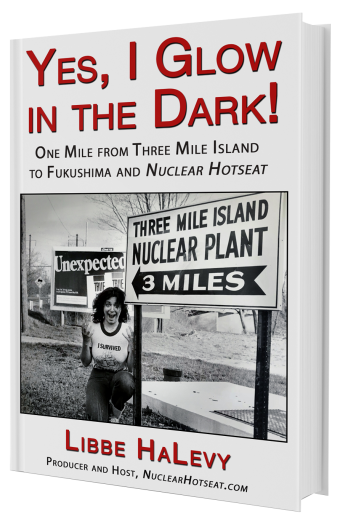
This is an exciting event with its in gathering of activists and filmmakers, literally from around the world. I have had the privilege of covering it in 2015 in Quebec and 2016 in Los Angeles, and hope to again, be able to attend the events in New Mexico, to on the films and interview the filmmakers and other activists for nuclear hot seat. And speaking of travel. I'm about to go on my first book tour down to San Diego on Thursday, September 13, where I will be at grassroots Oasis from six to nine. That's where I will be reading from my book. Yes, I glow in the dark one mile from three mile island to Fukushima and nuclear hots seek including passages about what it was like to be alone in the house with no transportation and hear that nuclear warning message coming down the street in Middletown, Pennsylvania, how the nuclear industry uses the same techniques as sexual abuse perpetrators to keep it victims silenced and disempowered, and how, what I call nuclear spin speak language.
Libbe HaLevy
05:54:32
Manipulation keeps letting the nuclear industry get away with what they get away with. I will also be providing an up to the minute update on what's been happening at San Andre. That's the same week that the nuclear regulatory commission and will be examining Sanofy in light of the August three near miss of a major accident. So there may be some very compelling, timely updates provided. And before you leave, we'll all have time for networking and organizing. If you've already bought a copy of the book, bring it on down and I'll sign it for you. And if you haven't yet, we'll have a limited number of books available for purchase onsite. Again, Thursday, September 13, six to nine at grassroots Oasis in San Diego. And I will have a link to the Facebook invite up on the website, nuclear hotseat.com under this episode, number 3, 7, 6 here's today's final thought enough about me.
Libbe HaLevy
05:55:30
I'm gonna finish up this recording and head out to nature. And I suggest you do that too. Being in touch with the beauties of Earth's natural environment reminds us all of exactly what it is that we're fighting for. This has been nuclear hot seat for Tuesday, September 4th, 2018 material for this week show has been researched and compiled from nuclear news.net to UN renard.wordpress.com. Mining awareness.wordpress.com. Try dash city herald.com and the ongoing reporting excellence of Annette carry the guardian.com national press.org courtesy Alice Slater, the bulletin.org, propublica.org, federal register.gov Dana appointer.com O brag.org C n.acs.org. K news.net Mitsubishi. Morta the former Japanese ambassador to Switzerland, Japan times.co.jp as sahi.com. Business tech.co Doza, bologna.org haka magazine.com green socialist.org, counter punch.org. The sold dead cubicle drones who grind out those press releases for world nuclear news, the us nuclear regulatory commission, and a big loving shout out to all of you.
Libbe HaLevy
05:56:53
Nuclear hot seat listeners and followers around the world. You are in 123 countries on six continents, and we are counting and a big welcome to everyone. Who's listened on our growing network of broadcast stations around the us. If you know of a community broadcast station, that's looking for a nuclear program. Please put us in touch with each other. I would love to be able to help them out. The music written by me sung by Mary Lee Weber accompaniment by John Barnard recorded at Winslow court in Hollywood. If you have a story lead, a hot tip or a suggestion of someone who interview send an email to info nuclear hotseat.com. And if you appreciate weekly verifiable news updates about nuclear issues around the world, take a moment to send a donation of any size to nuclear hotseat com. We will really appreciate your support. Nuclear hot seat is copyright 2018 libe Halian heart history, communications, all rights reserved, but fair use aloud. As long as proper attribution is provided. This is Libey of heart history, communications, the heart of the art of reminding you that with nuclear, the number one issue is, and must be long range safety for people and the environment. Pass it on. See you have just had your nuclear wake up call. So don't go back to sleep because we are all in the nuclear hots seat,
Announcer
05:58:28
New Claire hot seat. What are those people thinking? New Claire hot seat. What have those boys been drinking? New hot seat. The is our time to act is shrinking, but the activists are licking clear, hot seat. It's Deba.