Episode transcript
Nuclear Hotseat #783 - June 30, 2026
Setting the Record Straight!
Ketterer on RECA Radiation Testing in Colorado & NM,
Gundersen Testifies to NRC Against Palisades Restart
Libbe HaLevy: [00:00:00] Nuclear contamination testing. It's one thing to know that an area you may live in has a history of nuclear radiation contamination, but how do you find out how bad the situation is now? And how can you determine if it qualifies you for inclusion in the US government's Radiation Exposure Compensation Act, or RECA?
That's the federal law that provides partial restitution to individuals or their survivors who develop serious illnesses after being exposed to radiation from US nuclear weapons programs or uranium mining. But when your situation parallels the one in North St. Louis, which has qualified for RECA status, and you have not, it takes a genuine expert, a scientist dedicated to impeccable testing and data to back up his claims on behalf of [00:01:00] radiation exposure victims, and he tells you.
Michael Ketterer: Canyon City never was afforded this status in the 2025 legislation, despite the fact that from the scientific standpoint, you know, from the lens at what I look at things, this is Coldwater Creek of the West. Those sites are joined by the hip. It's the same kind of stuff. And so to me, you know, my position as a scientist is I don't think it's right that one is afforded RECA status and another area is not, and that's why I'm opening my mouth.
Libbe HaLevy: And he's doing a whole lot more than that. Well, when Dr. Michael Ketterer explains the unfairness of excluding certain radiation-contaminated sites from government compensation while allowing identical situations elsewhere to qualify for compensation, and the difficulties in gathering information, evidence that supports expansion of the government program, you see yet another facet of that awful, [00:02:00] deadly, dangerous seat that we all share.
Numnutz of the Week Theme: Nuclear hot seat. What are those people thinking? Nuclear hot seat. What have those boys been drinking? Nuclear hot seat. The corium is sinking. Our time to act is shrinking, but our activists are linking. Nuclear hot seat. It's da bomb
Libbe HaLevy: Welcome to Nuclear Hot Seat, the weekly international news magazine keeping you up to date on all things nuclear from a different perspective. We're a show for people who know nothing about nuclear who want to know something, and people who know something who would like to know just a little bit more.
My name is Libby Halevi. I'm the producer and host, as well as a [00:03:00] survivor of the nuclear accident at Three Mile Island from just one mile away, so I know what can happen when those nuclear so-called experts get it wrong This week we talk with Dr. Michael Ketterer. He is an analytical chemist and professor emeritus of chemistry and biochemistry at Northern Arizona University.
He specializes in understanding the sources, transport, and environmental fates of long-lived radioactive contaminants, such as uranium and plutonium, near former and active nuclear sites, and he's been doing some important testing in radioactive hotspots that have not yet been included in the Radiation Exposure Compensation Act, or RECA.
And we will hear testimony by nuclear engineer and whistleblower Arnie Gundersen to the Nuclear Regulatory Commission about the dangers of restarting the Palisades Nuclear Power Plant on Lake Michigan. [00:04:00] It's a nuclear facility which has been shut down and up on the blocks since May of 2022. Arnie provides damning information about the state and dangers of cracks in the steam generator pipes, information that is backed by Holtec, the owning company, by their own engineers.
But will the NRC listen? Still to be determined. We will also have nuclear news from around the world, Numbnuts of the Week for outstanding nuclear boneheadedness, and lots of honest and verifiable nuclear information, all of it coming up in just a few moments. Today is Tuesday, June 30th, 2026, and here is this week's nuclear news from a different perspective.
Starting out here in the US where, in Michigan, the pressure continues to restart the Palisades nuclear reactor on the shores of Lake Michigan, a facility that has been shut down and on [00:05:00] the blocks since May of 2022. There are many serious concerns which were raised in testimony to the Nuclear Regulatory Commission by Arnie Gundersen, a nuclear engineer and whistleblower familiar to listeners of Nuclear Hot Seat.
Here is his testimony.
Arnie Gundersen: In full disclosure, this morning I am video copying my presentation in order to ultimately share it with the press. Preservation of this video record will prove my client's attempt to prevent a catastrophe when Palisades experiences either a steam generator or a safe end failure if, or rather when, the NRC allows Palisades to restart I'll discuss my white paper's key areas of concern.
First, there's nothing in the public document room, nor in the historical record of nuclear power, that shows a discovery of steam generator tube damage two [00:06:00] hundred and fifty times greater than during the previous outages inspection. Nor is there any precedent in the historical record that shows eight safe end welds in need of repair after a single outage.
Yet for Palisades, the NRC is, has not required Holtec to determine the root cause of this extensive outbreak of safe end and tube damage. Second, there's nothing on the historical record, nor in the PDR, where a nuclear power plant was allowed to restart after it sat for two years with unmonitored water chemistry in excess of EPRI water quality standards.
These two problems are obviously intertwined, yet the NRC has never demanded a root cause analysis from Holtec, as it did on Millstone 1 and Turkey Point 3, nor has the NRC ever asked Holtec to [00:07:00] analyze any lingering effects for chemical hideout that may cause further long-term damage if Palisades were to return to service.
Third, Holtec, Framatome, and the NRC have fallen into a logical trap called survivorship bias. There are no known instances of gross tube failures, two hundred and fifty times in one refueling outage, nor of extensive safe end degradation, eight times in one refueli- outage, nor of unmonitored pH control and oxygen scavenging for two-year periods.
But Holtec, Framatome, and the NRC have relied on the operational data from reactor cooling systems and steam generators, which have never experienced similar failure rates or poor extended water chemistry. You're relying on inappropriate [00:08:00] analogs, which have never experienced similar conditions as those at Palisades.
Fourth, Holtec assumes that the A steam generator will be the first to fail and has not re- addressed the potential that the B steam generator may fail. May fail first. The conditions within each steam generator are independent variables of each other, which therefore almost doubles the probability calculated by Framatome of catastrophic damage.
Fifth and finally, Beyond Nuclear and Don't Waste Michigan have repeatedly statio- stated that steam generator failure at Palisades is inevitable given one, two, three, and four above. Now, Framatome agrees with us that tube failure at Palisades is likely if Palisades were allowed to operate for only 18 months, and that the failure [00:09:00] probability increases exponentially as time goes on.
That's Framatome Add in survivorship bias and you get the frightening prospect that exponential damage is highly likely, and tube or safe end failures will occur sooner and more extensively than Framatome predicts. Yet the PRB has remarkably rejected the information from the public and implicitly from Framatome with these three assertions.
One, the facts specified in the petition do not provide support for the requested action. Two, the issues raised have previously been subject to a facility-specific or generic NRC staff review. And three, the petition does not provide significant new information that the staff did not consider in prior review.
It's difficult to imagine how the Petition Review Board could reach such an [00:10:00] outrageous conclusion in light of the mountain of troubling evidence we have presented, and in light of the lack of support within the public document records. The Trump administration has publicly pressured the NRC to expedite reactor licensing reviews.
Holtec has stated that restarting Palisades is a cornerstone in its upcoming ten billion dollar initial public offering. The public may be excused for viewing the situation as the Petition Review Board slow walking the two point two oh six petitions while fast-tracking the Palisades restart. We may also be forgiven for failing to understand how you can, uh, reject the consensus between Framatome and my clients that exponential failure at Palisades Steam Generator is likely before Palisades reaches its scheduled eighteen-month [00:11:00] refueling.
The conclusion is obvious, the failure of Palisades Steam Generator tubes, tube sheets, and safe ends inevitable well before the license ends in twenty thirty-one. I think the NRC has abdicated its legal responsibility to ensure that Palisades is safe. Full stop, safe. And instead sees its role as approving Palisades as safe enough To begin operation for a period of time.
There's no other explanation since no other nuclear plant has experienced the rapid degradation of steam generator tubes and safe end wells. The NRC has fallen into the logical trap of survivorship bita- bias. I'm here to tell you that you're betting on the wrong survivors and overlooking world-class incompetence that risks a world-class catastrophe on Lake Michigan.
[00:12:00] I've been active in the nuclear industry for 55 years. When I'm asked to assist a public filing on a 2.206 petition, I always advise that they are 99% doomed to failure at the NRC. That's about to happen again with the 2.2 pet- 2.206 petition we're discussing today. Here's hoping that you prove me wrong.
Thank you.
Libbe HaLevy: Nuclear engineer and whistleblower, Arnie Gundersen, in testimony to the Nuclear Regulatory Commission on the proposed restart of the Palisades nuclear reactor on the shores of Lake Michigan in Michigan. And now for a slightly different perspective, here's...
Numnutz of the Week Theme: Nuclear hot seat. Nuclear hot seat.
Nuclear hot seat. None that sound-
Libbe HaLevy: Hurry, hurry, hurry. Speed is more important than safety and accuracy. [00:13:00] It's the new nuclear race. Gotta make that deadline the president set so that the optics line up with July 4th. But at what possible ultimate cost? A little over a year ago, President Trump set a numb-nuts goal.
He wanted to see American companies build at least three new experimental nuclear reactors by July 4th, 2026, the 250th anniversary of the signing of the Declaration of Independence. Shortly thereafter, Trump signed an executive order enshrining his goal, and the Department of Energy launched its Reactor Pilot Program, which is designed to help companies build and run test reactors quickly, in part by radically cutting back on regulations required for such reactors, meaning safety regulations.
And industry responded. On June 4th, Antares Nuclear announced it had [00:14:00] gone critical. No, it's not criticizing the rules. It's starting up a quickly built reactor. And Valar Atomics said it went critical on June 18. One observer, Nick Touran, who is chief nuclear officer at Ocean Atomics, which seeks to put nuclear power onto civilian ships, said, "We haven't done anything this fast basically ever."
Did you bother to think that maybe there was a reason for that? The speed has sparked alarms According to Ed Lyman, director of nuclear power safety at the Union of Concerned Scientists, the race is, quote, "Essentially an exercise in public relations. This is taking us back to the 1950s, and that is not progress."
To get the reactors built this quickly comes at a cost. NPR reported that the Energy Department completely rewrote its safety and security standards to make it easier for companies [00:15:00] to win regulatory approval, and the department has said that safety has not been compromised. Really? And in order to make that statement, DOE consulted with the companies, but not with the public.
It also exempted new reactors from environmental review. So is there a problem? Who's to know? Ed Lyman of UCS continued, "Yes, of course. If you bend all the rules, you can do things quickly." The test reactors might be working, he said, quote, "But that should not be confused with anything related to a nuclear power reactor that's capable of producing electricity in a stable and safe way."
So who is the numbnuts here? President Trump? The Department of Energy? Those nuclear companies who took the bait? There's room for all of them under the umbrella of this week's-
Numnutz of the Week Theme: Nuclear Hot Seat: Numbnuts of the [00:16:00] Week
Libbe HaLevy: Here's this week's featured interview. How do you prove that you've been exposed to and your health has been damaged by World War II radioactive nuclear weapons waste, or as the result of uranium mining?
This is so you can become included in the government's compensation program. Well, this week we talk with Dr. Michael Ketterer. He is an analytical chemist and professor emeritus of chemistry and biochemistry at Northern Arizona University. Dr. Ketterer specializes in understanding the sources, transport, and environmental fates of long-lived radioactive contaminants, such as uranium and plutonium, near former and active nuclear sites, and he's been doing some important testing in radioactive hotspots that have not yet been included under the Radiation Exposure Compensation Act, or RECA.
Note that when Dr. Ketterer mentions [00:17:00] Canyon City as the Coldwater Creek of the West, he is referring to the area in North St. Louis that was contaminated by radioactive waste from the Manhattan Project and was pivotal in the passage of RECA. And when he refers to Trinity, that's the site of the test atomic explosion in New Mexico that took place a month before Hiroshima.
I spoke with Dr. Michael Ketterer on June 29, 2026.
Michael Ketterer: Dr. Michael Ketterer, it is always
Libbe HaLevy: a great pleasure and extremely illuminating to talk with you for Nuclear Hot Seat.
Michael Ketterer: Thank you, Levy. It's, uh, great to be here as always.
Libbe HaLevy: Let's start with Colorado, which is where you have been working most recently. There hasn't been a lot in the headlines about Colorado, but there are two active sites, contamination sites, that you have been addressing.
Tell us about Rocky Flats and Canyon [00:18:00] City.
Michael Ketterer: In the state of Colorado, which I live, at least when I'm home and not wandering around other places, but in Colorado there are two fairly well-known contaminated sites that go back to the early Cold War. One is called Rocky Flats in suburban Denver, northwestern suburban Denver, and the other one is called Canyon City Cotter Mill, and that's in Canyon City, Colorado, which is to the west of Pueblo in the Arkansas River Valley.
And both of these are essentially hazardous waste sites that were fixed, if at all, to a minimal extent and then turned over and now essentially forgotten about and left in unsupervised hands, and essentially not cleaned up. So start with, um, Canyon City because probably your listeners have [00:19:00] heard of Rocky Flats quite a bit more.
Canyon City is a small community about 40 miles west of Pueblo, and in 1950s, in the late 1950s, the Cotter Corporation started a uranium mill to do chemical processing of uranium ores which were abundant in Colorado and surrounding states. And so they were brought there and then milled with processes with treating them with acids and bases to extract the uranium.
The product of the mill, of course, would be yellowcake, and the waste material would be what are commonly called tailings, granular material that's just accumulated in enormous quantities. The uranium ore that is being mined is maybe 0.1 or 0.2% uranium by weight. The rest of it is garbage that becomes tailings.
The yellowcake made from a ton of ore is not very much, a few pounds maybe, and then the rest of it [00:20:00] becomes this waste. And then these materials cont- called the tailings retain all of the radioactivity. In Canyon City, this tailings management became a problem and essentially- In essence, it's been incompletely addressed.
It's a failed site where there is no longer uranium milling taking place. There has been some minimal level of enclosure and preventing people from going onto the site, but there are large piles of essentially unremediated solid materials just open to the winds. And then in addition to that, there's an area of the community, there's a surrounding neighborhood that's kind of north and east of the mill site that's called Lincoln Park, and it's within the city limits of Canyon City.
I would say, roughly speaking, we're talking about a square mile or so, but this appears to be a neighborhood that's heavily impacted both by the fugitive dusts [00:21:00] from the mill And that would just blow with the wind, as well as floods. This area flooded extensively in 1965 and swept, you know, essentially tailings through everybody's backyard and into their neighborhood.
And then in addition to that, there's contaminated groundwater. These places in this Lincoln Park neighborhood would otherwise be, you know, little small mini farms with one or two acres. Maybe somebody could have a horse or two and grow some gardens and have a well. Well, no more well because the State of Colorado is saying you can't use this water.
So that's an introduction to the problems in Cañon City. There's a group in Cañon City called Colorado Citizens Against Toxic Waste, or C-C-A-T, CCAT pronounced. I am a board member of CCAT, but the principles of CCAT know a, a whole lot, being Cañon City natives. Uh, Gerry [00:22:00] Fry and Carol Dunn are the co-chairs.
Anyway, the basic problem in Cañon City is uranium-contaminated groundwater, and then there's thorium-230 and radium and all the radon daughters and all those are in the soils mixed in from the mill tailings that are all over town, especially in this Lincoln Park neighborhood. They may even have done things like built schools and, you know, other structures using this stuff as filter.
Just the same story as happened in Grand Junction, Colorado. Cañon City brings me to some current federal legislation that is called RECA, or the Radiation Exposure and Compensation Act, and the last version of that just passed in 2025 with a short timeline to end of 2027, but it compensates people who live in and are affected by and get cancers of certain types from [00:23:00] either uranium mining and/or nuclear weapons testing fallout under certain defined conditions as spelled out in the program.
Well, Cañon City never was afforded this status in the 2025 legislation, despite the fact that from the scientific standpoint, you know, from the lens at what I look at things, this is Coldwater Creek of the West. You have talked to people from St. Louis, Just Mom St. Louis. I've been on Zoom calls and have listened to Karen Nickel and Don Chapman.
Well, you know, Cañon City is just the Western farm team of Coldwater Creek where they sent a lot of the thorium-230 there when they figured out they couldn't do anything else with it. Either that or they buried it in the West Lake Landfill and so forth. But those sites are joined by the hip. It's the same kind of stuff.
And so to me, you know, my position as a scientist is I don't think it's right that- [00:24:00] You know, one is afforded RECA status and another area is not, and that's why I'm opening my mouth. And I'm, on these calls, I'm not Representative Pettersen's constituent. Representative Brittany Pettersen is the Democratic representative of, in Colorado, whose district contains both these sites, Rocky Flats and Canyon City.
Representative Pettersen is now talking to a group of Coloradans who are interested in both Rocky Flats and Canyon City about including these sites in a new edition of RECA legislation, which is being written at this time as a bill
Libbe HaLevy: What has been your position in all of this? Specifically, I'm talking about the Arthur S.
Ratcliffe Mobile Community Laboratory and how it is being deployed.
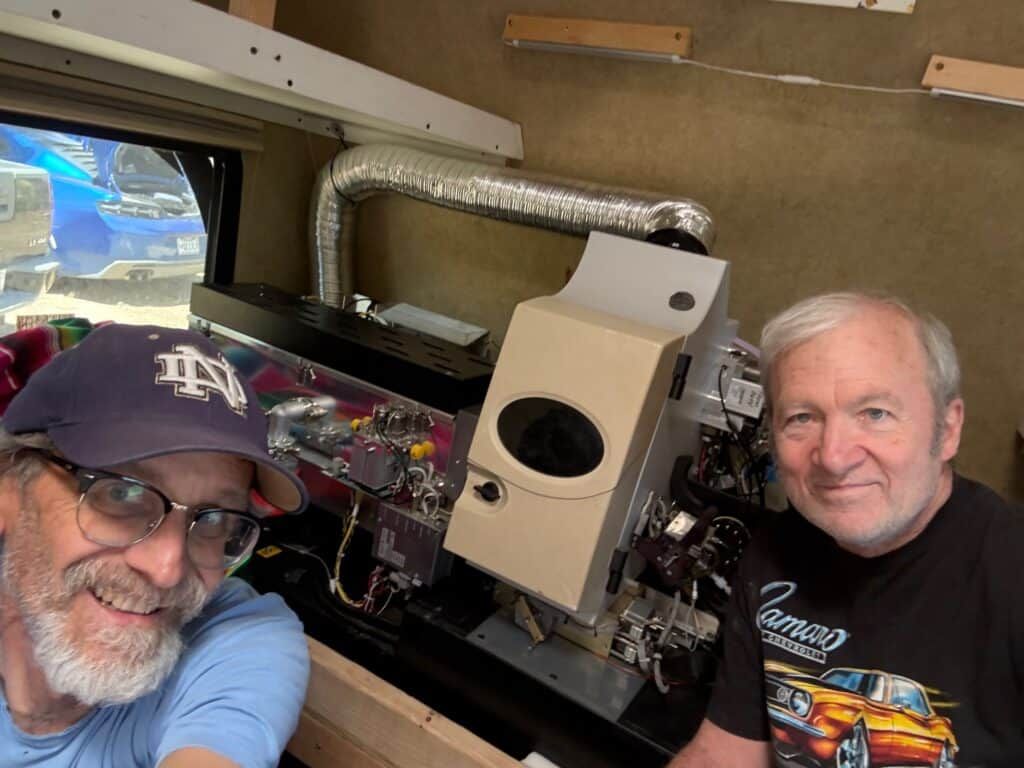
Michael Ketterer: I think that's an excellent question, and I can synthesize a lot of things together here. [00:25:00] Working with Veterans For Peace, myself and a few others built an outreach tool called the Arthur Ratcliffe Mobile Environmental Lab. It's a 17-foot trailer, uh, that can be towed around, and it contains a mobile metals testing laboratory.
We can measure uranium concentrations, and we can look at water and soil and sediments. We can also do other types of heavy metal analyses. But the idea is, is that it is a tool that is well-suited for bringing to sites where the contamination exists. In fact, in May and in June, I worked in concert with CCAT in Canyon City.
Our Veterans For Peace mobile laboratory worked in concert with people in Canyon City to test their water, to look at is there uranium concentration, is there an issue with this there? And the answer is yes, there is some [00:26:00] concern. There are samples that are in excess of the drinking water standard for uranium, and they are probably groundwater samples.
I've been testing them as blind samples. But we began this work with the Ratcliffe Lab, and I began working with the Canyon City group, CCAT et al., with the explicit idea of I wanna see myself a new, robust RECA passed that supersedes and is much better than what we have now, that compensates people in many, many more sites.
Because the lens that I look at the world through is I don't really care about the politics of any of these situations or whose district it is, or what the history of the site is. I go and measure contamination and I say, "This is the same as that," just like I'm saying here today. Canyon City contamination is the same thing as Coldwater Creek, and [00:27:00] it's the same logical argument to me as to why in 2025 New Mexico finally prevails.
It's logical to me to say that Trinity is the same stuff as the Nevada test site, and so therefore it's logical to me to say that Rocky Flats contains some of the same bad stuff, too, as in these other locations. And there's a well-known area of plutonium contamination that the government has admitted to for more than 50 years is there, and it's still there.
Libbe HaLevy: When you talk about the uranium contamination, uranium does occur naturally as ore throughout Colorado. Is there a way of separating the naturally occurring wild uranium that's in the environment and the uranium that might show up as a result of human intervention in the environment, which causes it to show up in samples?
Michael Ketterer: Those are excellent [00:28:00] questions, and I deal with all of that, and it's always central to any kind of study to try to figure out, you know, am I looking at something that really is a problem that nature did itself, or did humans have something to do with it? And when it comes to uranium, it can either be uranium of normal isotope composition that came from nature itself, and that's what we would call NORM, technologically enhanced NORM sometimes, naturally occurring radioactive material.
Or in the case of a place like Piketon, Ohio, where you've been messing with its isotope composition through enrichment, then it has a very, very distinct isotope pattern to it which is instantly distinguishable. But we are always, always looking to answer that question. It gets trickier in a place like Canyon City, but here are some of the things that one might look for.
The background Earth's crust [00:29:00] concentration of uranium is maybe three, four micrograms per gram. And one of the things one would look for in Canyon City is if I'm getting soils that are several times that, maybe 15 or 20 or 30 micrograms per gram, and it's, you know, it's uranium and it's naturally occurring uranium, it might have something to do with this mill.
It might not just be, you know, this is an aberration of the local soil. If the uranium has been milled, you know, if it's been through a milling process and we're looking at tailings, then it's pretty easy to spot because here's what happens. They want to take the uranium out at the uranium mill. That's the money product.
The rest of it, everything else in the uranium 238 series is garbage. It's called tailings, and it contains such stuff as radium and thorium 230. Thorium 230 is the isotope that I look for, and if I just compare thorium 230 and uranium [00:30:00] 238, those two are found in nature in a very predictable proportion. I know what to see.
There's a pattern that I see. If somebody has milled uranium ore, the thorium 230 is all there. That's all garbage. Send it to Canyon City or dump it out in the tailings impoundment. The uranium has been taken out, so the relationship is instantly identifiable. So that's one of the things that one can look for.
We've seen that to be the case in some surface soils in Canyon City, th- that, you know, it's clear that they're, they're being influenced by tailings. The thorium 230 is elevated and it's distorted versus the uranium I think that it's possible to say that there's impact that way. When it comes to the groundwater, it's a little bit trickier, but there's a paper that goes back to 1990s by the US Geological Survey by an author Zielinski, Z-I-E-L-I-N-S-K-I.
[00:31:00] And I, I have read the paper and I know him, and he developed a way of fingerprinting the uranium using isotope measurements, and we're looking into that, and that could be done if we find samples, and we found a few, where the uranium concentrations were elevated
Libbe HaLevy: How are your samples collected, and who are the people who do this work?
Michael Ketterer: The way this works is as follows: the laboratory, with myself being the lab manager and having a few assistants here and there, we analyze blind samples. Basically, we get test tubes from some kind of a sample custodian person. We get test tubes with numbers on them, 347, 736, just serial numbers on them. I analyze those samples in a completely blind manner.
I know who gave them to me, but in a way it's even better if I don't even know that or [00:32:00] I don't remember, you know. Somebody else unpacks the boxes or something like that. But the idea is that the Ratcliffe lab analyzes water samples, and we test for several metals, including uranium and arsenic and lead and some other bad actors, and then we produce a blind report.
That goes from me, the lab manager, to the community coordinator or sample custodian person. So what I do is not interface with the members of the public directly, but I recruit a community volunteer, somebody who's interested in this, you know, kind of like a block captain who wants to pass out test tubes to their neighbors, collect some sheets, and then get the information back from me.
So then what I will do is I will produce a computer file folder that has PDF files with the individual reports that [00:33:00] say, "Dear Sample 347, here are your results." And most of the time it says, "There are no water quality concerns with respect to these specific constituents that we have tested." And then there's a bunch of disclaimers and so on and so on.
In some cases, it says things like, "The lead concentration here that you have is between two and 10 micrograms per liter. This is entering your water artificially through some kind of corrosion process. The 10 is the, is the standard, but it's two today, but maybe it could be 10 tomorrow. You have water...
You, you should look into this and, you know, I recommend that you not drink this water if you can help it because lead is not something to mess around with, particularly if you have children." This now has nothing related to Eureka, but we find these bits of information out as a matter of course.
Similarly, in Colorado and New Mexico, in U- in community-submitted water samples, we're [00:34:00] finding a lot of samples that have elevated arsenic, a few here and there in both states with arsenic above 10 micrograms per liter. Also, uranium above 30 micrograms per liter is- And that shows up at Canyon City, and in some of those cases, I'm blind so I don't know, but I think it could be related to...
Th- these are samples that are from the mill that are affected by the mill. They are groundwater samples. I'm hypothesizing this without knowing where they came from, just, just judging from the fact that the concentrations are that elevated. They are not Canyon City tap water because all of those are the same and they are all low
Libbe HaLevy: This kind of circles around a general concern that many of us have, which is that the government sets official acceptable limits for radiation exposure, and some of us think that those are rigged on behalf of [00:35:00] industry, government, whoever is working with these materials, getting away with having something acceptable that really in terms of human health is not acceptable.
Would you consider the levels that radiation is set at currently to be fair, or do they need to be lowered to be more in line with what's best for human health?
Michael Ketterer: I would say they're either fair where they are or they should be made lower. The worst thing that we could do, and I, I'm not coming from the perspective of I am a risk assessment person and I'm not looking at it from, uh, toxicology or health physics or anything like that.
I'm just thinking in terms of, you know, what has been public policy for decades when it comes to, say, a substance... L- l- let's take uranium in water. Uranium in water has a standard of 30 micrograms per liter, and that's [00:36:00] based on its mass concentration. That's not what, whether it's radioactive or which isotope it is, it's, that's its mass concentration, and of course it's mostly 238.
You know, that exists for a reason. There are always r- scientific rationales for why that standard exists, and if you just indiscriminately say, "Well, we don't think 30 is a good number. Why, why don't we just ignore it, or why don't we just say 100 is easier to deal with 'cause it's cheaper?" You know, there's consequences.
With uranium, I think one of them that's quite clear as a consequence is kidney disease and the impacts on a renal system in humans from uranium exposure, and this seems to have more to do with its, its properties as a chemical toxin, as a heavy metal, so to speak, as opposed to being radioactive. There's an association that's known between uranium and kidney disease, excess uranium in water.
And there's, you know, in the United States there's [00:37:00] many areas where there is excess uranium in water, and many of them are very much naturally occurring that have nothing to do with any human endeavor at all. Canyon City is definitely one that has something to do with human endeavors that occurred in the Cold War era, for sure
Libbe HaLevy: We'll return with the second half of this week's featured interview with Dr.
Michael Ketterer in just a moment. But first, Nuclear Hot Seat is going through an evolution and expansion, both in honor of the start of our 16th year and because, let's face it, in a world awash with nuclear issues from local to global, there is no better time for people to become aware of this show, its archive of more than 780 episodes going back 15 years, and its ongoing intent.
To that end, the website is being upgraded, we're launching a YouTube channel, and social media campaigns are being mapped out to spread the word every week [00:38:00] in order to build listenership. I've assembled a team that is not only skilled in their respective online platforms, but also staunchly against nuclear.
Big plans, but not without a cost. And that's why I'm reaching out to you. Whether you're a long-term listener or just discovering the show now, Nuclear Hot Seat is here for you every week with news, analysis, expert interviews, humor whenever possible, and more honest nuclear information than you'll find anywhere on mainstream media.
We talk with physicists, scientists, researchers, on-the-ground activists, legislators, filmmakers, and other artists from around the world about all aspects of nuclear, from uranium mining to refining to reactors and weapons and the forever curse of radioactive waste. And you can be assured that we'll always come from a different perspective, rather than one pushed by the relentless multi-million dollar [00:39:00] nuclear industry pre-hour propaganda campaign that is working so hard to brainwash us into thinking that nukes are good and necessary when they are neither.
That is why you need Nuclear Hot Seat. Right now would be a perfect and important time to help us out with a tax-deductible donation. Any amount will support the work, be it a one-time donation or to set up a recurring monthly gift of as little as $5. It will help us make an important difference. Or in honor of the start of our 16th year, how about $16 or more?
Don't limit yourself. It all goes towards keeping this show alive and expanding. As I mentioned, we're a 501[c][3] nonprofit organization, which means that your donations are tax-deductible. Go to nuclearhotseat.com, and there's a red Donate button there. If you have Zelle, you can send money directly to [00:40:00] info@nuclearhotseat.com.
But whatever you do, don't wait. Please donate now by going to nuclearhotseat.com, and know that whatever you can do to help, I'm grateful that you care and that you're along with us as we move into an expansive, hopefully nuclear-free future Now here is the conclusion of this week's featured interview with Dr.
Michael Ketterer.
Michael Ketterer: You've mentioned RECA and also New Mexico.
Libbe HaLevy: How has the Red Cliff Mobile Community Lab been deployed in New Mexico? What was your purpose in being there, and what does it show as regards RECA?
Michael Ketterer: We are off to an interesting start in that we did a lot of the development work in New Mexico over the winter when it was based in Bernalillo, to the north of Albuquerque, and then one of the first things that we did was a public effort on water analysis [00:41:00] with the Tularosa Basin Downwinders in March, and we analyzed some 80 water samples or so, and then the next one became Canyon City.
Now, in July, the lab is now back in New Mexico. We are located in a community called Peñasco, which is up near Taos, and it is near one of the pueblos that's called the Picuris Pueblo, and that's spelled P-I-C-U-R-I-S. We have set up at a community center up there and we'll be assisting people both in the pueblo and in the surrounding community to answer some of their questions, you know, and much of it is of course related to water.
But getting into RECA, when you go into these communities in northern New Mexico, everybody is concerned about, well, you know, was there fallout from Los Alamos here? Was there fallout from Nevada here? What about Trinity? Did it reach up here? They're concerned about all those things. What about the fires?
People [00:42:00] have a lot of worry about fires spreading contamination from more contaminated areas over to land on where they live. People have legitimate fears about that.
Libbe HaLevy: Re-aerosolizing the- Yeah ... radioactive particles, as we experienced here in Southern California- Yeah ... with the Woolsey Fire and radioactive particles being found as far away as 9.2 miles in Sherman Oaks- Uh-huh
when the only testing was done within 10 miles. So that's pretty dramatic.
Michael Ketterer: Yes. Well, people in some of these areas in northern New Mexico, uh, they have all of these concerns, and so we have plans to be testing for soil and, uh, other media, dust from attics and things like that. The mobile lab can do certain types of testing.
I should point out that plutonium is something that's very much of concern if we are talking about the Los [00:43:00] Alamos contribution or the Trinity contribution, et cetera. We can test that in the mobile lab to some extent. It does not have a radioactive materials license. We cannot really quantify how much there is, but we can measure its isotope composition.
We can say it looks like it's either a little bit or a lot, and we can say whose it is. And often saying whose it is is more important than anything else. Who did this is revealed. The lab is essentially doing is serving as a forensic tool, and also as an outreach tool to show people how this all works.
It's a forensic tool to answer questions like, yes, it came from there and not from there. I go by, you know, several basic principles that, one, I need to make things very, very obvious when I show people results or if I bring them into something sophisticated like a mobile laboratory and I wanna convince them of something like, a simple example is your [00:44:00] water sample is 100 micrograms per liter of uranium.
I can take them into the mobile lab and I can show them that obviously by comparing it to a standard that's 30 micrograms per liter, the drinking water standard. So I wanna make things obvious, is one of the things that we built this tool to do, and I think it does that. The other thing that I think I'm compelled to do always is to defend not only myself, but defend the public against false explanations.
Libbe HaLevy: Tell us more about that.
Michael Ketterer: I think the last time we were talking, I was describing a book I was writing that was about nuclear fallout and so forth, and, uh, it weaves in a, a bunch of stuff about activism. But one of the principles that I go by is, in the work that I do, which is science, you know, the first thing I wanna do is to make it obvious what is the true explanation.
I want-- That's the [00:45:00] first thing I wanna do. But the second thing I wanna do is I want to be ruthless in fighting off all BS explanations. And, and, it, you know, it's extremely important to be, to be, uh, you know, to be very consistent and to be very immediate and, and dismissive of anything that's nonsense. It, it has to be done that way, or it is no longer science.
I am no longer a scientist if I don't check people on those things. Now, in my book, I'm gonna use analogies from my favorite spectator sport to watch, ice hockey. So the first one, make things obvious, is called the Bobby Orr analogy, and the second one, that's the defense against bullshit, I'm gonna call that the Keith Magnuson analogy.
And to see how those unfold, you, you, you'll have to wait another several months till I've written more. But I wanna use the mobile lab to do both of those things because, [00:46:00] you know, these people in northern New Mexico, they need to know what's obviously true, and they also need to know what is not true.
What have they been told that's not true, or what are they worried about that really is not a legitimate concern? I think it's fair to say many members of the public do have misconceptions, either for good or bad, about certain things. And I function really in a, you know, very much an evidence-based world.
I don't really have opinions so much as I evaluate samples and then I say, "Well, this is what this sample says, and therefore this is what my opinion is." It's stemming from the evidence itself. There's no way that I can take a sample of some soil from a place like Chupadera Mesa in New Mexico, basically across the street to the north in the direction of the Trinity cloud.
There's no way that I can take that sample and say, "Hmm, this was not impacted by [00:47:00] Trinity," just because I don't wanna have to say that. You know, that's not how my world works. You know, I'm a fraud if it does work that way, and it's... So I wanna make that obvious, you know? You think you've got a sample that looks like Chupadera Mesa?
I've got a little bottle of that in my chemistry set, and we'll have a look. That's what the mobile lab does.
Libbe HaLevy: Given that you are, if I may use the word, such a gadfly when it comes to those people who may be pushing false narratives for their own purposes, what kind of pushback have you and the program, the testing program you have put together, received, or has there been any?
Michael Ketterer: Honestly, Libby, there really hasn't been any in 2026 because we've been very quiet and we've been busy doing our work building the laboratory and testing people's water. And as I was describing earlier, I've been involved in some outreach and lobbying activities on RICA, trying to get that passed for beh- on [00:48:00] behalf of Colorado and other states.
So I don't feel like I've been opposed But I think I've talked with you before about Acid Canyon in New Mexico and the plutonium in the water in New Mexico. That one has not gone away, and it is now monsoon season again. And so I would just have to say that I think that's a matter that needs to reemerge in public importance.
And to remind everybody again of the situation, Acid Canyon is right by the Los Alamos Aquatic Center. During the Manhattan Project itself in '43, '44, somewhere in there, the government workers on the Manhattan Project dumped the barrels off the side of the canyon at the present day Aquatic Center, dumped all this plutonium in there.
The government subsequently made somewhat of a cleanup in the '60s and so on, and then in the '80s turned it [00:49:00] over to the county, and it's now public open space. And, uh, when it rains, the water that trickles through the canyon had on the order of 80 picocuries per liter of plutonium, which is above the federal gross alpha standard.
But the bad situation here for New Mexico is if this were in Colorado, Colorado, because of Rocky Flats, has a standard of 0.15 picocuries per liter for plutonium in water, but no such standard exists in New Mexico. So that is a disparity that I keep pointing out again and again and again. As you see here, inconsistencies are bothersome to me.
They bother me on things like RECA, and they bother me on compliance with, uh, uh, reasonable environmental regulations. To me, 0.15 is very reasonable. If you wanna make plutonium pits, why don't you have a [00:50:00] rigorous water standard in your state?
Libbe HaLevy: With you coming up with so much new data, how is this going to be incorporated, or what is being done to incorporate this into RECA to convince them to expand the areas that are covered by the Radiation Exposure Compensation Act?
Michael Ketterer: I'm glad that you asked that, and I'm actually, I've been very pessimistic about this for a long time, that I was not really achieving anything or getting anywhere. But I would have to say, in recent weeks I've become very optimistic about what I'm seeing with the RECA discussion on Colorado. And I think without too much m- more additional effort, that can be cloned into some other places that need it, such as those counties in Southern Ohio we've talked about, Pike and Scioto, over and over again.
I think we can get more sites into public attention that way. Coming back to one that I talked about with [00:51:00] you some time ago, which really has gone nowhere I'm sad to say, is Inyo and Mono Counties in California. Those are the Nevada upwind counties which have loads of Nevada fallout. And I have tried to stimulate, well, the UCS groups, the Union of Concerned Scientists, uh, RICA group.
I've tried to stimulate their interests in that, but so far we don't have any community members, and nobody has yet approached Representative Kevin Kiley, I believe is the person who is the representative of that district
Libbe HaLevy: So where are you and the Radcliffe Mobile Community Lab going next?
Michael Ketterer: Well, uh, we're going to be, I think, concentrating on New Mexico for the next two to three months.
Uh, the schedule is a little bit uncertain. We have logistical things that we're trying to sort through, myself and my lab co-leader, Brian Wilcox, his name is. We both have to pay [00:52:00] attention to the fact that we are mortals and can, can't push ourselves too hard. But we are expecting to make a trip in the latter part of 2026, TBD.
We are expecting to make a trip to Tennessee and to Ohio to deal with what we see, w- to visit and address what we see as the RECA needs in Unicoi County, Erwin, Tennessee's location, Washington County, where Aerojet and, uh, Telford and Jonesborough are, and downstream of there is Greene County. And then in Ohio, of course, those two counties in southern Ohio, Pike and Scioto County, where the Portsmouth former uranium enrichment plant was at Piketon.
So we're expecting to make a trip there, but in the meanwhile, in the next couple of months it's gonna be... We've got a lot to do out west of, of the Mississippi. I think the [00:53:00] real message that we have to people that ask is, this effort should really be cloned in other places. It's clear to us that's true already.
You know, Canyon City needs its own laboratory because there's so much work right there, and we're talking about that. It's obvious to me that both these counties in Tennessee and in Ohio could both each support their own laboratory. We- there's that much work there just in those locations.
Libbe HaLevy: Well, it sounds like quite a road trip.
I wish I could join you on it, or at least for part of it. Anything you haven't had a chance to speak on today that you'd like to add at this time?
Michael Ketterer: I'd just like to say that in recent weeks becoming immersed in a lot of these RECA discussions, I just wanna make a pitch to the victims. This is just really about you, and what I'm really doing is to work for you here.
Yeah, we are all downwinders, and if I look at every zip code I've lived in in my life and all the Superfund sites and so [00:54:00] on near there, I'm surely a downwinder too, but I've been fortunate enough to not yet be affected in the health sense by it. So I think I owe it to you, the victims, to be doing what I'm doing.
You know, that's what we conceived of this Radcliffe lab as a tool to do.
Libbe HaLevy: It's remarkable work, it's important work, and hopefully it will serve as a role model for other labs to be created and other programs to be put forward in the areas that need it, which unfortunately is far too much of this country.
Michael Ketterer: Indeed. We're thinking about things like describing our work in papers and s- there's actually journals in citizen science. We see this as something that communities can do for themselves if they're shown the way.
Libbe HaLevy: Well, if I get contacted by anybody who's interested in knowing more, I'll be certain to put them in touch with you.
Michael Ketterer: I get those contacts regularly, and I appreciate them all. Thank you, Libby, for the enjoyable talk today. It's great. And thank you, Dr. Michael Ketterer, for being my guest [00:55:00] this week on Nuclear Hot Seat.
Libbe HaLevy: Dr. Michael Ketterer. You can find pictures of the mobile lab and links to his work on our website, nuclearhotseat.com, under this episode number 783.
Activist Shoutout: Activist shout outs.
Libbe HaLevy: There's a film we are linking to called Nuked, which examines the hidden legacy of United States nuclear weapons testing on Bikini Atoll in the Pacific, and its people. Through moving testimonies, rare archival footage, and expert insight, it reveals how these Marshall Islanders were uprooted from their homes under the false promise they'd return, only to face radiation exposure, displacement, and the loss of centuries-old culture.
The link to the film will be up on our website, nuclearhotseat.com, under this episode number [00:56:00] 783. A shout-out with massive congratulations to Back From The Brink, which just launched their new limited podcast series. The show is hosted by award-winning journalist Ryan Blackshear Vargas, and offers an approachable entry point for anyone concerned about nuclear weapons, but who struggles to imagine a world without them.
You can find this show on the Back From The Brink website, on Spotify, on Apple Podcasts, or wherever you get your podcasts. And here's the good news, the first three episodes are already out. The rest will be released every Thursday until the finale on July 23rd. That's the Back From The Brink podcast, and Nuclear Hot Seat Podcast salutes you.
And a call for calls to all of you from Vina Colley of PRESS, Portsmouth Piketon Residents for Environmental Safety and Security in Portsmouth, Piketon, Ohio. They are trying to get their highly [00:57:00] contaminated area included under RECA, the Radiation Exposure Compensation Act, but the records necessary to support their claims are classified and have been withheld.
This penalizes not only local residents who have been and continue to be exposed, but those workers who have been on site since after the 1992 cutoff date. PRESS is asking for email and calls to the office of Congressman Dave Taylor. The phone number is two O two two two five three one six four, and email is Taylor, that's T-A-Y-L-O-R.house.gov.
We will also have those both up on the website, nuclearhotseat.com, under this episode number 783. And we're scheduling a longer interview with Vina Colley on these issues for an upcoming Nuclear Hot Seat This has been Nuclear Hot Seat for [00:58:00] Tuesday, June 30th, 2026. You can get Nuclear Hot Seat delivered via email every week by going to the website nuclearhotseat.com.
There's a big yellow opt-in box that you will see. Fill in your first name and an email address. You'll get it every week as soon as the show posts. Next up, if you have a story lead, a hot tip, or a suggestion of someone to interview, send an email to info@nuclearhotseat.com. And remember, always, if you can go to Nuclear Hot Seat and donate, thank you.
Any amount will help us out, especially with the changes that we are making, and we always appreciate your support. This episode of Nuclear Hot Seat is copyright 2026 Libby Halevi and Nuclear Hot Seat. All rights reserved, but fair use allowed, as long as you cite the program, website, names of any guests whose [00:59:00] comments you use, and me.
For now, this is Libby Halevi of Nuclear Hot Seat reminding you that ignoring the impact of nuclear radiation on our lives and health doesn't change the scientific fact of what it is doing to harm us. It just keeps us trapped in ignorance and danger. There you have it, your weekly nuclear wake-up call.
So whatever you do, do not go back to sleep, because we are all in the nuclear hot seat
Numnutz of the Week Theme: Nuclear hot seat. What are those people thinking? Nuclear hot seat. What have those boys been drinking? Nuclear hot seat. The corium is sinking. Our time to act is shrinking, but our activists are linking
Nuclear hot seat. It's da [01:00:00] bomb