Episode transcript
Nuclear Hotseat #785 - July 14, 2026
HOW Many New Nukes?!?!?
Los Alamos Plutonium Pit Production Demands
and Other Insanities -
Greg Mello, Los Alamos Study Group
Libbe HaLevy: [00:00:00] Nuclear weapons expansion. How many nuclear weapons are enough? According to our current government, no such number exists. Not only are the two sites that make plutonium pits, the plutonium-containing trigger mechanism for nuclear bombs, under orders to increase production to 80, eight-zero, pits per year by 2030, with Los Alamos National Laboratory directed to increase its minimum production capacity to 60 pits per year, now they wanna push that number up to 200 pits per year by 2050.
Remember, each plutonium pit represents a separate nuclear weapon. Considering that each one of these is typically 20 to 80 times more powerful than the bomb dropped on Hiroshima, how in the world does this expansion make any sense? It takes a genuine expert, [00:01:00] someone who focuses on Los Alamos National Laboratory and its place in the national nuclear discussion, to nail the truth.
And when he tells you-
Greg Mello: I've come to believe that all these arguments and justifications are downstream from the financial and political considerations that fund the contractors and the pork barrel politicians like we have in this state, and they are basically patched on the hind end of the, uh, decisions after they are made, and they are made because of money.
Libbe HaLevy: Not a surprising conclusion, and one that sums things up. So when Greg Mello, co-founder and executive director of the Los Alamos Study Group, explains that this rush to build more nuclear weapons is less about national security and more [00:02:00]
Nuclear Hotseat Theme: lear Hotseat. What are those people thinking? Nuclear Hotseat. What have those boys been drinking?
Libbe HaLevy: Nuclear
Nuclear Hotseat Theme: Hotseat. The corium is sinking. Our time to act is shrinking, but our activists are linking.
Nuclear Hotseat. It's da bomb
Libbe HaLevy: Welcome to Nuclear Hotseat, the weekly international news magazine keeping you up to date on all things nuclear from a different perspective. We're a show for people who know nothing about nuclear who would like to know something, and people who already know something about nuclear who would like to know just a little bit [00:03:00] more.
My name is Libbe HaLevy. I'm the producer and host, as well as a survivor of the nuclear accident at Three Mile Island from just one mile away, so I know what can happen when those nuclear so-called experts get it wrong. This week, we talk with Greg Mello. He is co-founder and executive director of the Los Alamos Study Group.
He has a long list of issues about what's happening at Los Alamos National Laboratory, and he's about to bring us up to date on all of them. We will also hear from Alistair Burnett in Geneva, Switzerland with an update from the International Campaign to Abolish Nuclear Weapons, or ICAN. This time, he's focusing on NATO.
We will also have nuclear news from around the world, all of it coming up in just a few moments. Today is Tuesday, July 14, 2026, and here is this week's nuclear [00:04:00] news from a different perspective. Starting out with Alistair Burnett, media director of the International Campaign to Abolish Nuclear Weapons with the ICAN update, this time focusing on NATO.
Alistair Burnett: Hello, this is Alistair Burnett at ICAN in Geneva with the latest from the International Campaign to Abolish Nuclear Weapons. I'll start off with some good news. As of this month, the Treaty on the Prohibition of Nuclear Weapons now has one hundred countries as either states parties or a signatory. The Kingdom of Tonga in the Pacific acceded to the treaty on the seventh of July.
It also signed and ratified the Comprehensive Nuclear Test Ban Treaty on the same day. Last month, ICAN published its annual Global Nuclear Weapons Spending report. It showed that the amount the nine nuclear-armed states spent on their arsenals in twenty twenty-five jumped again to one hundred and nineteen billion dollars.
That's three thousand seven hundred and sixty-eight dollars [00:05:00] per second and a huge nineteen percent increase on twenty twenty-four. The other main finding was that private sector companies earned at least thirty-eight billion dollars from their nuclear weapons contracts. As in previous years, the United States spent more than all the other countries combined, a cool sixty-nine point two billion dollars.
Washington also had the largest annual increase at twelve point four billion dollars. China was the second-largest spender at thirteen point five billion, while the United Kingdom overtook Russia to become the third-largest spender at twelve point six billion to Russia's nine point five billion. Using the evidence available from some governments, we also looked at longer-term spending projections as the nuclear-armed states continue to modernize and in some cases expand their arsenals.
Figures from France, the UK, and the US show billions more dollars will be spent in the decades ahead that will saddle a new generation with the existential threat of nuclear weapons. [00:06:00] Some of these weapons systems are planned to last into the next century. The report also highlighted how this money could be spent on real human security and improving people's lives.
A minute of nuclear weapons spending could provide access to clean water and sanitation for three thousand four hundred and seventy-eight people. A day of this spending could protect two million people from food insecurity. A week of this money could protect more than twelve billion people from measles, mumps, and rubella, and a year's spending could provide more than six million homes with solar power.
Apart from the rocky truce between US and Iran, which seems to be constantly on the brink of collapse as the two sides try to negotiate a long-term deal to settle the issues between them, NATO leaders have just met in Turkey for their annual summit. The headlines from the meeting in Ankara were dominated by President Trump's repetition of his demand that the US take control of Greenland and his insults and economic threats [00:07:00] against other members, particularly Spain.
In their joint statement, the leaders also repeated their demand that Iran should never have a nuclear weapon, conveniently ignoring that there is a country in the Middle East that already has a nuclear arsenal, Israel. They also spent a lot of time talking about the threat they see from Russia without acknowledging their own role in heightening nuclear tensions with Moscow.
In our response, ICAN pointed out that NATO's three nuclear-armed members outspend Russia 10 times on nuclear weapons, but they still don't seem to feel secure. ICAN's advocacy coordinator, Florian Ebelingkamp, works with campaigners in NATO countries, and I asked him what he made of the summit.
Florian Eblenkamp: Maybe what's most striking is actually how little was said about nuclear weapons.
So maybe that, that silence on nuclear weapons is, is more of a message than, than what the text actually says. And it shows you how normalized nuclear weapons have become inside NATO's thinking. It's not something they need to debate anymore or that, [00:08:00] that needs a consolidated position at the moment.
That's a problem, especially in a year when arms control is falling apart and new states are talking about joining the nuclear club. I think it's the responsibility of those states particularly that have nuclear weapons and that claim nuclear weapons for security purposes to at least have one sentence on de-escalation in that declaration.
Alistair Burnett: ICAN's recent global nuclear weapons spending report showed that the NATO members' nuclear-armed states, Britain, France, and the US spent $90 billion on their nuclear arsenals last year to Russia's 9.5 billion. Why do they still seem to feel so insecure, do you think, about Russia?
Florian Eblenkamp: Yeah, this is a good observation, and it begs the question that if 10- spending 10 times more than Russia on nuclear weapons is not enough, then how much is actually enough?
Or are nuclear weapons maybe just a terrible security strategy? Of course, nuclear weapons are [00:09:00] never only about numbers. It's not really about the size of an arsenal to inflict damage, right? If you wanna cause a apocalypse, a few nuclear weapons can be enough. So in a sense, nuclear weapons have become a strategic problem for NATO, that they're locked into spending an insane amount of money on these weapons.
Uh, UK, for example, going up to 25% of their entire defense budget just for those weapons. That's, of course, an opportunity cost for other, other things that the state could spend money on, including, of course, also conventional military capabilities that might actually increase national security. But of course, nuclear weapons cannot be used in any way that complies with, you know, the basics of international law, as these weapons are indiscriminate by design.
Therefore, there will always be a hesitancy to use them, and of course, if you really feel threatened by Russia, then it's probably smarter to invest in things that you can actually fight Russia with. So I think that investment in nuclear weapons is a problem for NATO, and it's [00:10:00] precisely the reason why they feel insecure
Alistair Burnett: NATO countries are, in many ways, identified as the main obstacle to nuclear disarmament, and the main opponents of the Treaty on the Prohibition of Nuclear Weapons, the TPNW, seem to be concentrated in Europe.
So what do you think can be done? What more can be done to get them to change their position?
Florian Eblenkamp: Yeah. So just this week, we had the hundredth state sign up to the treaty, Tonga joining the Treaty on the Prohibition of Nuclear Weapons, which is, of course, more and more a sign that NATO has become this isolated block of countries that refuses to engage with what a global majority of countries has already realized.
And that's, of course, that nuclear weapons are not, uh, necessary or permanent or in any way a legitimate means of defense. What's needed is to stigmatize nuclear weapons more, to increase the political and the actual costs for nuclear weapons. And that's what we, what we do at ICAN, of course. We try to, to keep building the treaty's membership so [00:11:00] that NATO states are even more isolated, that they feel they are really the only ones holding out, that their position is not the norm anymore, and that they eventually then start engaging.
But of course, it's also, um, about campaigning in the civil society sense. We also need to push financial institutions and pension funds to divest from nuclear weapons producers. We need to push parliamentarians to make it as uncomfortable as possible for governments to refuse to engage. We need to keep demonstrating at the nuclear bases in the countries where nuclear weapons are stationed and, of course, keep highlighting the reality of what nuclear weapons do when they are used.
Still a long road to go, but with every state that joins the Treaty on the Prohibition of Nuclear Weapons, that pressure increases, and the weaker NATO states will look when they refuse to join.
Alistair Burnett: That was Florian Ebeling Camp. And if you want to check out our global annual nuclear spending report, just go to ICAN's website, www.icanw.org, and search for [00:12:00] premeditated and spending report, and that'll bring it up This is Alistair Burnett ending this news roundup for Nuclear Hotseat.
Libbe HaLevy: Here's this week's featured interview. The Los Alamos National Laboratory is ground zero in the rapid expansion of production of nuclear weapons here in the United States. LANL, as it is called, along with the Savannah River Site, is tasked with building plutonium pits, the firing mechanism that ignites the nuclear material in each of these bombs.
LANL is under orders to build 80, 8-0, plutonium pits per year, and now the Trump administration is pushing for an edict of a combined 200 pits per year by 2050. Can you spell nuclear apocalypse? When we already have the ability to blow up the planet with the 5,000 nuclear weapons our country already has, this makes no rational [00:13:00] sense, at least not to any rational person.
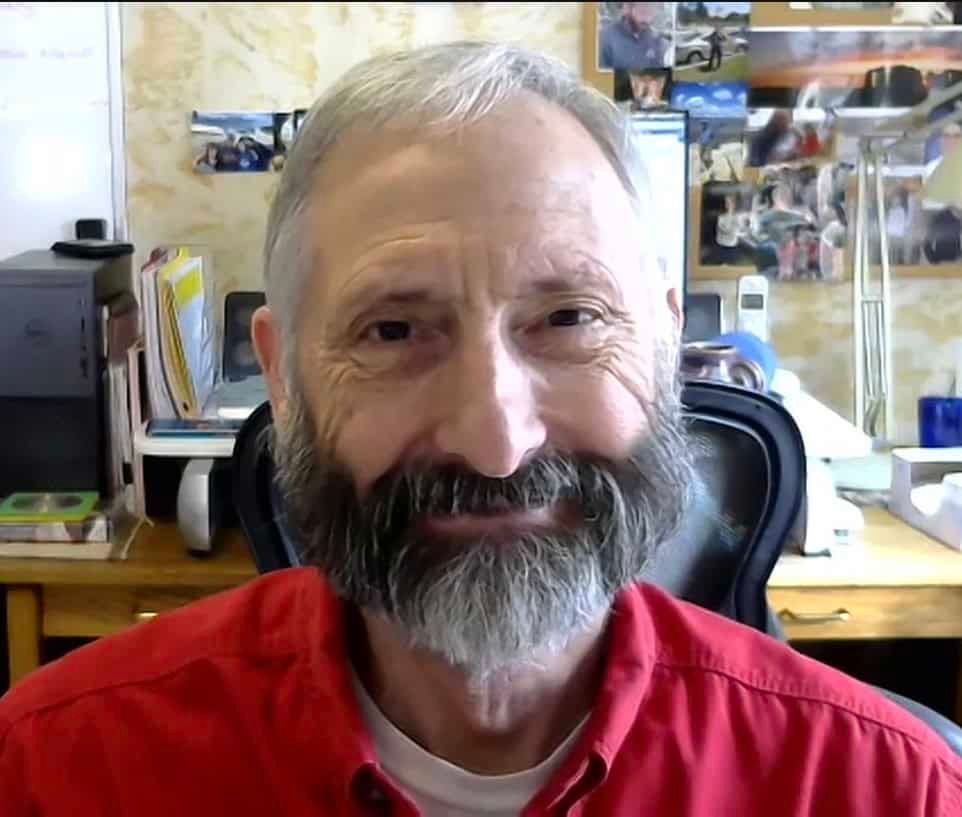
But there is a reason, and it's obvious once you understand, and the person to help you understand it is Greg Miller He is co-founder and executive director of the Los Alamos Study Group, and has led its varied activities since its inception, including policy research, environmental analysis, congressional education and lobbying, community organizing, litigation, advertising, as well as the nuts and bolts of funding and running a small nonprofit.
His credits are too extensive to be cited here, but trust that he is an experienced expert who watches LANL down to the nanos, and calls them out on all levels of nuclear boneheadedness. To learn more about the many issues involving LANL today, I spoke with Greg Mello on July 10, 2026. Greg Mello, it's always great [00:14:00] and highly educational to have you back on Nuclear Hotseat.
Greg Mello: It's wonderful to be here, Libby.
Libbe HaLevy: You sent me an email where you tried to catch me up on what was happening in and around Los Alamos National Laboratory, and I have to say the list was staggering. So let's see if we can get it all into this program, because there is a lot. Let's start with the legislation.
There's some pending legislation called H.R.8800. What is it asking?
Greg Mello: That is the National Defense Authorization Act, which is a gigantic piece of legislation, happens every year, and it's the main vehicle of the national security state, you might say. And it has a nuclear component, and there's a warhead component, which is what we focus on quite a bit.
And there's this [00:15:00] shocking proposal there to require the Department of Energy and its National Nuclear Security Administration component, NNSA, to acquire the capacity to reliably produce 180 nuclear warhead cores, or pits, as they're called, per year by 2050. Now, that's a large number, much larger than we have seen.
It's more than twice as big as existing legislation. But this 2050, that's a long way from now. So we're unsure what the thinking is behind this, and we couldn't find, of the people we talked to in Washington, any of them who knew exactly what that meant and why that came
Libbe HaLevy: And what they're asking to be able to do is to create the ability to make 180 more, not just [00:16:00] pits, but bombs, nuclear bombs- Yeah
by 2050. 180 a year? Why in the world would that be needed?
Greg Mello: Well, that's a very good question, and it's really more than that, Libby, because the language is the, to reliably produce this each year. Well, it has a special meaning, and it means that in nine out of 10 years they will produce at least that many.
And when they model the production, it means that the average production is gonna be about 30% higher than that. So they say 180, but if it's 180 reliable, well, that makes it more like 230 or something like that, on the average. It's a code.
Libbe HaLevy: It's insane because any one of those bombs is magnitudes larger than the ones that were dropped on [00:17:00] Hiroshima and Nagasaki, and we've seen how devastating they were and how long-lasting the effects were on the people, on the hibakusha, and on their offspring, and on their grandchildren.
So to think of the creation reliably, not talking about the ones that are the misfits, but reliably of 180 magnitudes larger bombs per year, that makes no human sense.
Greg Mello: No, it does not. And this does not include the weapons, the warheads that they will make by recycling components from warheads they already have or from components which they have in storage.
So there would be other new warheads and bombs built besides those. This really just is, you might say, the stream of brand-new plutonium [00:18:00] weapon cores. Up to now they've been recycling them, and they, uh, changed them slightly, but this would be the brand-new ones. Right now they have a requirement to make 80 in 2030, but there's a, a gap, in a way, a legislative hole.
There's no actual law requiring them to make any of them after 2030, and maybe they're trying to fill that hole.
Libbe HaLevy: How is this legislation being received in Washington? Does it have support? Is there pushback?
Greg Mello: It's likely to pass the House. There wasn't pushback from some of the progressives, from any of the progressives on, uh, if you wanna call them that, on the House Armed Services Committee.
In order to cut it out of the House bill, it's gonna require some concerted effort. And it is not, however, present in the Senate version of the bill, and I'm going to [00:19:00] come to the Senate The Senate, we know, is a little worried that the Trump NNSA is biting off more than it can chew, running ahead of its headlights, or like that excellent song, uh, Casey Jones, Watch Your Speed.
They're not doves, but they're worried about crashing the system because the Trump administration is too eager to say yes to every kind of new nuclear weapon idea that somebody, some hair-brained person suggests. So if they keep going this way, they're gonna crash, and that is the concern of the, you might say, the responsible hawks.
Is there any doves? No, we can't find any. No doves
Libbe HaLevy: And when you say the system [00:20:00] could crash, what does that mean and what might that look like?
Greg Mello: Well, as we'll get to in a minute, there, for example, was a fire in a glove box at Los Alamos National Laboratory. No one was hurt, but 200 people were evacuated, work stopped.
This was just recently. And if this happens too much, even if nobody's hurt, then things will begin to gum up. And if people were hurt, it would really damage morale, and there would be investigations. And this is how a plutonium facility comes to a grinding halt, and they cannot afford that. They cannot afford to put too much pressure on the people who are working there at 3:00 in the morning making new nuclear weapons, [00:21:00] because that is what they are doing.
It's a crazy thing, isn't it? Working around the clock 24/7 to make these parts for nuclear weapons as fast as possible so that Mr. Trump and his successor will have as many new nuclear weapons as possible, on top of the 5,000 or so that we have today.
Libbe HaLevy: To what end?
Greg Mello: It's madness, and it's the, uh, strange idea that by making more nuclear weapons, we can shield ourselves from nuclear weapons.
I've been to the Heritage Foundation and talked to them about this, and they want nuclear weapons in order to attack Chinese airfields. They don't feel comfortable, they, not just Heritage, but the entire nuclear weapons establishment, doesn't feel comfortable not having enough warheads to reliably destroy every single Russian [00:22:00] warhead and every single Chinese warhead, with some left over for North Korea, and all at the same time.
They just don't feel comfortable without at least some notion that they will win a nuclear war.
Libbe HaLevy: And if that's not an oxymoron, I don't know what is. Nobody wins a nuclear war.
Greg Mello: I've come to believe that all these arguments and justifications are downstream from the financial and political considerations that fund the contractors and the pork barrel politicians like we have in this state, and they are basically patched on the hind end of the, uh, decisions after they are made, and they are made because of money.
Libbe HaLevy: Nuclear is the ultimate Ponzi scheme. Are there any other pieces of legislation we need to be aware of [00:23:00] that are in the process of working their way through the system?
Greg Mello: Sure. There's a mystery in the parallel process of appropriating money to pay for all this. The House Appropriations Committee proposes to cut more than $5 billion out of the NNSA's warhead activities budget, which is, in my living experience, unprecedented.
I do not fully understand this. We couldn't see them because they were wrapped up in their legislative work, and they go into kind of a secret status. Nobody can talk to them. But it appears that there is that much extra money that has accumulated in the NNSA's bank account, partly because of the One Big Beautiful Bill Act, and partly from before [00:24:00] that.
They get to accumulate money that's not spent from year to year, and they have a piggy bank.
Libbe HaLevy: So they want to go on a binge and buy lots more nuclear bombs, pits?
Greg Mello: Well, that's, I think, is what they would like to do, but apparently the Republican-led House of Representatives Appropriations Committee would like them to spend from their piggy bank if they're going to spend that much money.
The Trump administration proposes a gigantic growth year on year in nuclear warheads. The House wants to cut that way back. They'll s- there would still be a 2% increase, let's say for inflation, but none of this gigantic increase.
Libbe HaLevy: In other words, that they just didn't spend from year to year and have been accumulating for one big nuclear splurge?
Greg Mello: Well, the [00:25:00] nuclear bomb business is unique in government in that when the money is made available, it doesn't have to be spent in the year that it's given. It is available until expended. So if you end up spending 90% of your budget, you have 10% left over forever, and to a first approximation. And so there are different little piggy banks for different line items, and NNSA keeps track of those, but so do the appropriations committees.
And finally, it appears somebody is saying, "Wait just a minute now. You've got a lot of quarters and nickels here." And we're talking about billions here, really. You need to spend from your allowance. Uh, you're not getting a 30% increase in your allowance.
Libbe HaLevy: You always [00:26:00] stun me with the specificity of your information, and also the way that you can expose some of the true insanity that underlies the entire nuclear enterprise.
Greg Mello: It is really nuts. And I think people constantly are prone to underestimating how much these people are actually in control of government, and both parties. So it's very rare to find anybody who will stand up to them.
Libbe HaLevy: You've mentioned now a few times the Defense Nuclear Facility Safety Board, or DNFSB, regarding federal safety oversight of personnel at Los Alamos National Laboratory.
What's that about?
Greg Mello: I think that's really interesting. Los Alamos, let's go back all the way to 1943. We have General Groves trying to figure out where to put the lab that would put together the bomb. [00:27:00] After all the pieces and materials are made somewhere else, you would need a few people to assemble it.
But that place would have to be very remote because of spies, and because he didn't want the scientists going on weekends to see their fellow scientists in a big city. So he picked a place that was remote but pretty, because Oppenheimer thought that was necessary, so he picked Los Alamos.
Libbe HaLevy: And didn't Oppenheimer have a private ranch in that area as well?
Greg Mello: Yes, on the other side of the mountains. Not too long ago, the president, or excuse me, the CEO of Los Alamos said, "Well, Los Alamos lab is at the end of the world's longest cul-de-sac." He was talking about how hard it is to get people up there, and how hard it is to attract people to live [00:28:00] there with the limited housing that's available, and there's only a few ways to get in there.
So when DOGE came to town in DC and said, "Well, we'd give you an opportunity to retire early if you want," well, it turned out that the federal workforce, some of it was commuting from Albuquerque, which means a four-hour drive every day. It was what many of the employees called, according to NNSA, the terror part of their day.
Because of the traffic jams, the narrow roads, the road rage. One contractor that was doing work on the side of the road, he said he seen at least one incident of road rage every day. Because people are very frustrated, they wanna get to work, they're stuck in traffic. California-style traffic, one manager said, in New Mexico.
[00:29:00] So these people quit, and their workforce suddenly got smaller.
Libbe HaLevy: When did this take place?
Greg Mello: In the first part of the second Trump administration. So you would think, "Well, we'll just hire some more people because these people are retiring anyway." Well, it's not so easy. New Mexico has the worst educational system in the United States.
New Mexico is at the bottom of a great many social metrics. It was, until recently, the very worst state in which to raise a child. Now it is next to the worst. It's difficult to find doctors and specialists. It's difficult to find veterinary. It's a complex and challenging place, and Los Alamos Lab, the contractor, is losing between eight and 900 people each year.
So if they wanna grow, they have to hire at least that many [00:30:00] people every year. Now, returning to the much smaller federal workforce, they're paid a lot less than people who work at the lab, and they have a safety oversight role, some of them. Well, they're very valuable people, and they're valuable in the nuclear industry, which is undergoing a kind of renaissance, as you know.
I am quite sure that a seasoned federal safety engineer could command at least 50% more pay working for one of these nuclear startups in any number of places in the United States, and wouldn't have to worry about trying to pay for private schools, wouldn't have the commute. These jobs are not w- really jobs that you could do from your home.
You need to be in the plutonium facility, looking with your eyes at this [00:31:00] stuff. So the long and the short of it is they're hard to replace, and the NNSA has not been able to replace them, so they are down about 25%, even at the same time as the Los Alamos lab is going to 24/7 work with this greatly expanded workload that's being pushed on them by the Trump administration.
Libbe HaLevy: So it's an expanded workload without an expanded workforce.
Greg Mello: Especially a federal safety oversight workforce. That's the hard part.
Libbe HaLevy: And wasn't that the group of people who Trump has just dismissed?
Greg Mello: No. So there's a group of people headquartered in Washington, and they have a couple of people in Los Alamos, just two I think, whose job it is to look over the shoulder of the feds and point out if something looks terribly off-kilter, [00:32:00] and report to Congress and to the Secretary of Energy.
They're kind of like senior advisors. They don't have power. They're not like a regulatory body, but they do have a lot of experience and integrity and intelligence, and they're very valuable. And strangely, the Biden administration failed to appoint board members that oversee the staff during his four years, and Trump is also not appointing new board members to provide the seasoned leadership for this staff of about 100 people that cover all of Department of Energy nuclear facilities across the country.
So there is just one board member when there should be five, so there's no quorum to take the official actions that [00:33:00] would really put more pressure on the NNSA or DOE in general when pressure is needed. Dr. Patricia Lee is the only one there. The professional staff is still there, but that's just the beginning of what's going on.
The... Well, first I should say that the Trump administration doesn't even count them as existing since they don't have a quorum. Uh, he doesn't appoint people there, so they can't get a quorum, and he doesn't consider them as really even existing at this point. So there's a memo from the NNSA saying, "Don't pay attention to what the DNFSB may be telling you."
And they're denying, uh, access to meetings, access to documents, access to data systems. And [00:34:00] meanwhile all of this is going on, they have something... They, DOE, has a project called Project Velocity. Have you heard of this?
Libbe HaLevy: The email from you was the first time I've heard of it, so please explain.
Greg Mello: Project Velocity is an effort by a very few political appointees and their immediate staff to talk to the lab directors and vet about 80 safety orders and regulations to see what can be done away with or streamlined.
And they're doing this without input from the nuclear safety community. The Defense Nuclear Facility Safety Board is not involved, has- does not know what's going on. The nuclear safety experts within the Department of Energy [00:35:00] themselves don't know this. Some of the site contractors are not in the loop.
The only people in the loop are the lab directors and the administrator of NNSA and his immediate staff. So they're doing a wholesale review of all these safety orders and getting rid of some of them that could slow down projects, get rid of all the red tape, so they can produce nuclear weapons faster
Libbe HaLevy: The two words I always say on the show that you never want to hear in connection with nukes is cheaper and faster, because neither one augurs well for our future safety, and health, and life on the planet.
Greg Mello: Exactly. And not only that, that's not their only effort along these lines. They are... started to issue more exemptions [00:36:00] from the orders that they have, so that they don't actually follow their own orders. You might not realize that a nuclear facility might not have the same level of, let's say, electrical code compliance that your local Taco Bell has.
Libbe HaLevy: I know Taco Bell can be explosive on certain levels, but nothing like a nuke.
Greg Mello: So they're not just e- issuing individual exemptions from regulations, they're doing it in bulk also, and they are issuing exemptions to the general worker safety rules that are the ones parallel to OSHA. Since there's no OSHA at these sites, they're issuing exemptions that apply to non-nuclear safety as well.
And then construction standards, uh, as I indicate in the case [00:37:00] of the electrical, they are also cutting corners there, things that they don't feel are as important, and that will speed up the projects. This combined with completely blocking out all external advisory opinion is creating a very dangerous situation.
And in terms of the Defense Nuclear Facility Safety Board, which was created only after and because of the enormous worker and public health hazards that the country endured during the Cold War, this is being pushed right off the table into the trash can, and they are overturning 30 years of nuclear safety practice and paradigms that have been in place for so long, like the [00:38:00] ALARA principle, as low as-
Libbe HaLevy: We'll return with the second half of this week's featured interview with Greg Mello of the Los Alamos Study Group in just a moment, but first Nuclear Hotseat is going through an evolution and expansion, both in honor of the start of our sixteenth year and because, let's face it, it's time.
In a world awash with nuclear issues from local to global, there is no better time for people to become aware of this show, its archive of more than seven hundred and eighty episodes, and our ongoing intent. To that end, the website is being upgraded, we're launching a YouTube channel, and social media campaigns are being mapped out to spread the word every week.
We aim to build the listenership and start going viral. Big plans, but not without a cost. Still, it's going to be worth it to build a long-term future for the show, its archive, and a [00:39:00] structure that will sustain it for years to come. That's why I'm reaching out to you. Whether you're a longtime listener or just stumbled across this show by accident and are here now, Nuclear Hotseat is here for you every week with news, analysis, expert interviews, and more honest nuclear information than you'll find anywhere on mainstream media.
We talk with physicists, scientists, researchers, on-the-ground activists, legislators, filmmakers, and other artists from around the world about all aspects of nuclear, from uranium mining to refining to reactors and weapons and the forever nature of radioactive waste. And you can be assured that will always come from a different perspective, not the one pushed by the relentless multi-million dollar nuclear industry PR propaganda campaign that is working so hard to brainwash all of us into thinking that nukes are good and necessary when they are neither.
And that's why you need Nuclear Hotseat. [00:40:00] And that's why right now would be a perfect and important time to help us out with a tax-deductible donation. Any amount will support the work, either as a one-time only donation or if you decide to set up a recurring monthly gift. As little as five dollars a month can make an important difference.
Or you can make it sixteen dollars in honor of the start of our sixteenth year. Or make it more. Don't feel you have to limit yourself. It all goes towards keeping this show alive. Nuclear Hotseat is a 501 non-profit organization, which means that your donations are tax-deductible. Just go to nuclearhotseat.com and click on the red Donate button.
If you have Zelle, you can send money directly to info@nuclearhotseat.com. Don't wait. Please donate now by going to nuclearhotseat.com and know that whatever you can do to help, I am deeply [00:41:00] grateful that you're listening and that you care. Now here is the conclusion of this week's featured interview with Greg Mello of the Los Alamos Study Group.
So safety is out, staff is down, hours are stretched, the demands are growing, so there's much more pressure on the people who are there. What is this doing to the people who are there and their morale on the staff, the ones that are still around?
Greg Mello: Well, this is an excellent question, and we are just trying to find out.
We have made a few calls to unions, and we have found that they don't know a lot of this. We asked them did they know that the maximum allowable dose of radiation at Los Alamos has been increased by a factor of five over what it used to be? No, they don't know. No one has told them. It is le- it is a legal requirement to tell them, but they [00:42:00] don't know.
Libbe HaLevy: And how have they responded when you have come to them with this information?
Greg Mello: I think it's too early to say. Around here, it's difficult for people to lift themselves above the mental fog that i- emanates from the labs because of the money. So if you wanna come work in the plutonium facility, you can put yourself into job classification even without a degree, four year degree, of 200,000 a year with rich benefits, or if you have a degree then the tops out at 400,000 a year with extensive vacation, maternity, compassionate leave, lots of stuff.
You can spend months off the job skiing in [00:43:00] South America, as some people do, on the government payroll.
Libbe HaLevy: One of the things you wrote to me, and I loved the wording even if I didn't like what it was referring to, is about how Congress is, quote, "Intoxicated with war and nuclear deterrence." What did you mean by that?
Greg Mello: It seems that each congressperson or senator is more warlike than the next. And you can't, I think, be part of this party system and, and be in good standing without being a very warlike individual. There are people on the fringes, but they seem to get primaried out. And we see even progressive stalwarts like Garamendi not having any amendments proposed that would cut any of this this year.
Libbe HaLevy: [00:44:00] You also wrote to me about the foundation-funded system of NGOs directing attention away from nuclear disarmament. Explain more about that.
Greg Mello: That is a big subject, and I just wanna touch on it. It's a lot easier to kind of nibble at the edges of the problem and not be out on your own. There's a certain tribalness about this.
People don't wanna get too far away from the State Department, let's say. People don't want to talk about US empire. Let's take the effort to get new nukes so that Chinese airfields can be attacked in a coming war with China. Well, what the heck, man? A coming war with China, why are we planning this? And who is [00:45:00] going to stand up and say, "We don't want to put the United States in a position of going to war with China"?
Well, the pivot to the Pacific was Obama's signature proposal, and it is embraced really by both parties. China is the new enemy, the bigger enemy now. And well, who's gonna say that we have to live with each other and be a country just like other countries and not the biggest bully on the planet? Well, the foundation-funded NGOs aren't saying this because that is a peacenik kind of idea that undercuts positions held by both political parties, and it's very uncomfortable socially for the people in the elite [00:46:00] foreign policy community, and there just isn't funding for nuclear disarmament the way that there is for a little bit of arms control.
Not too much, just a little.
Libbe HaLevy: Token.
Greg Mello: Yes. I'm gonna get in trouble, but I'm gonna quote a one wag who made a little jingle about nuclear weapons from this perspective. He said, "The point of view is something like not too many, not too few, not too old, not too new." Enough for me and none for you. And it's this sweet spot that the main funders, which are the agenda-setting funders in the field, are aiming for, and they do not want to, for example, attack the [00:47:00] rationale or the scale of the nuclear weapons labs.
We have two nuclear weapon design labs, plus Sandia to do the weaponization. Why do we have two nuclear physics labs amply funded? The combined funding is about $10 billion a year for these two labs. Why is that? They were created by Edward Teller and the Air Force, and then subsequently, you know, the Livermore Lab I'm talking about, to have another lab to compete with Los Alamos.
Why do we still have two labs competing with each other? Let's try to find a California progressive. I think there are 52 congresspersons in California. How many want to cut Livermore Lab? None. There are three congresspersons from New Mexico, but the California delegation is gigantic. An Obama administration official [00:48:00] explained to me, why is Los Alamos making plutonium pits?
It's because Livermore needs somebody to make the pits so they can have another nuclear bomb design project, lest their budget be cut. So Los Alamos ends up being the dirtier lab, the one which is the manufacturing part of the proposed W871 warhead for the new Sentinel missile, and not one single California congressperson will oppose it.
None of the major NGOs, the labs are sacrosanct in the NGO community as well. So you begin to get a picture after a while. The data points mount up like darts in a dartboard, and after a few decades you see that nobody's hitting the [00:49:00] spots in the middle, and you begin to realize that it's not accidental.
Libbe HaLevy: With all this going on, the question is always, is there anything we can do? Is there anything anyone can do? And I think to that end, I'd like to point up some of the work that you and your people have been doing in the New Mexico, specifically Los Alamos area.
Greg Mello: We have started a little program, let's call it outreach.
It includes confrontation. That's a type of outreach. We are fortunate that nuclear expert, uh, Ted Postol will be speaking in Los Alamos on this coming Tuesday evening, and we'll be up there, uh, having some meetings with people and having a little protest. We find that people are more responsive to signs critical of [00:50:00] pit production and nuclear weapons than we thought.
So we have some young people and sometimes people from the community visiting academics, and we are reaching out there just a little bit because something's wrong when you've got 8 or 900 people quitting the job. And we need boots on the ground. If people want to come and work with us, we have a congressional wing, you might say, and we have a Los Alamos-oriented set of activities as well.
If people wanna come here, we'd be happy to facilitate that. We need skills of all kinds as well as enthusiasm without initial skills People can do a lot of things from where they are, but it does take a little pluck. The defense budget as a whole is going to cost [00:51:00] more than 11,000 per household. That's a lot of opportunity going down the drain, not counting the risk, not counting the m- moral decline.
And I think that there's plenty of ways to help, plenty of ways to be effective with one's own political situation, including in lo- with local government. But we can't expect it to be easy, and we're going to have to jump in for the long haul. We aren't going to get nuclear disarmament without a modus vivendi with Russia and China specifically.
Libbe HaLevy: And what do you mean by a modus vivendi?
Greg Mello: We have to redevelop a capacity which we as a country seem to have lost, to see the world as our adversaries see it. We can [00:52:00] develop a certain amount of diplomatic skill right down on the citizen level. We have got to stop hating people and vilifying them. I recommended to a congressman he ought to take a congressional delegation and go there and start doing some diplomacy himself if he doesn't like what Trump is doing.
Look at what John McCain did. Why is the right, the warlike militarists and neocons so free to do their own personal diplomacy and stir up wars and coups all over the world? And the liberals and the people who say they want something different, why don't they go over and do some positive work themselves?
And if they don't do it, we have to do it
Libbe HaLevy: From some of what you wrote to me, you said that every Tuesday and Wednesday you are bringing young people along and [00:53:00] visiting academics. I believe that's in government- Yeah ... or that's at Los Alamos, and you want people to come and visit you.
Greg Mello: Yes.
Libbe HaLevy: That strikes me as being akin to the earliest days of the feminist movement, where we didn't necessarily know what we were doing.
We would have consciousness raising. We would sit in circles and just talk, without necessarily an agenda, but to learn who was there, what were the concerns, what did we wanna do, what were we seeing, what were we not seeing? And to have that kind of combined energy and thought process, including young people and the elders who have seen it, done it, and need to pass the baton before it's too late, share that information to stir up the kind of vision you just put forth of liberals going out and stirring the pot for peace, as opposed to stirring up the aggressions and the battles, and that the only way we can respond to [00:54:00] anything is with a warlike, confrontational attitude.
Greg Mello: Exactly. And what we are finding is that there are people, surprising people, who are beginning to have doubts about what is going on, even in the heart of the nuclear weapons complex. And we need to peck on the outside of the shell so they can break the shell from the inside. There's questions in the community, and they're coming from conservative places.
It's not just the peaceniks who are scratching their heads and saying, "Wow, what have we got ourselves into here?"
Libbe HaLevy: So it seems that the ongoing work which you are so diligent about being part of is to find those leverage places, stick the crowbar in, and see how much you can leverage it up to allow people, as I like to say on this show, a different [00:55:00] perspective.
Because if enough people go, "This is not sustainable," be it from the nuclear perspective or be it from the more personally involved "this is unlivable" perspective- Mm-hmm ... whatever it takes to bring those forces together to say, "Let's at least pause this long enough to rethink it, and through that rethink find a way to stop it," that's the pathway we're on, and you're on the front lines there chipping away and finding places to dig in with that crowbar.
Greg Mello: We're trying. I think that among the young people, they don't know... And this includes the young technical staff at Los Alamos Lab. They don't know what nuclear weapons do. You would think they would, but they don't. So we have an educational struggle or vocation, let's say. I think that we also don't recognize enough how positive [00:56:00] this work can be.
We are having a pretty good time here, and we wanna make sure that people who are working with us have a decent time. This is possible everywhere. We know that there's gonna be some hard times ahead for the country, and we need to kinda stick together as we face them. But what else are we gonna do except work for human dignity and survival?
Libbe HaLevy: Sounds good to me. Greg Mello, it is always educational, enlightening, challenging, and sometimes an awful lot of fun talking with you. And for now, I wanna thank you for being my guest again this week on Nuclear Hotseat.
Greg Mello: Thank you so much, Libby.
Libbe HaLevy: Greg Mello, co-founder and executive director of the Los Alamos Study Group.
We'll have a link up to their [00:57:00] website, lasg.org, on our website, nuclearhotseat.com, under this episode, number 785. At minimum, I urge you to sign up for their newsletter because it's extremely informative, and Greg is spot on with all the issues as soon as they come up.
Activist Shoutout: Activists' shout-outs. Shout-outs.
Shout-outs
Libbe HaLevy: Just a quick heads up that my play, Atomic Bill and the Payment Due, will have a free staged reading presented the anniversary of the US atomic bombing of Hiroshima in Bellport, Long Island, New York, by the South Country Peace Resource Group as part of their acknowledgement and commemoration of Hiroshima.
Note that two of the presenters are going to be Carl Grossman playing the role of Carl Grossman and myself. Details on the website, and we'll have more [00:58:00] next week. This has been Nuclear Hotseat for Tuesday, July 14th, 2026. Sign up to get Nuclear Hotseat delivered via email every week by filling in the yellow opt-in box on our website, nuclearhotseat.com.
For now, this is Libbe HaLevy of Nuclear Hotseat, reminding you that when nuclear weapons are framed as usable tools, the risk of catastrophe increases. There you have it, your weekly nuclear wake-up call. So whatever you do, don't go back to sleep because we are all in the Nuclear Hotseat
Nuclear Hotseat Theme: Nuclear Hotseat.
those people thinking? Nuclear Hotseat. What have those boys been drinking? Nuclear Hotseat. The corium is sinking. Our time to act is shrinking, but our activists are linking
[00:59:00] Nuclear Hotseat. It's da bomb